Interworking Between BFD and DHCP
This section describes the application scenario of interworking between BFD and DHCP.
Applicable Environment
To ensure network reliability, some enterprises use the dual-uplink networking. Usually, the DHCP link serves as the active link. In such case, the egress gateway of the company serves as the DHCP client, and the company obtains IP addresses from the DHCP server to access the Internet. Links such as PPPoE link serve as the standby links.
As the DHCP client, the egress gateway cannot sense the availability of the link on which the egress gateway resides. When the link fails, the gateway cannot switch the service traffic to the standby link rapidly, resulting in service interruptions.
The BFD-DHCP interworking resolves this problem. The association of the DHCP client with the BFD session enables BFD to dynamically determine the availability of the DHCP link according to BFD session status.
Typical Application
As shown in Figure 1, Router_A serves as the egress gateway of a building. All companies in the building access the Internet through Router_A. Router_B serves as the egress gateway of a company in the building. To ensure network continuity, the company uses the dual-uplink networking, with DHCP and PPPoE links as the active and standby link respectively.
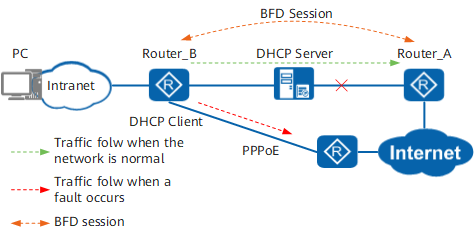
To ensure that the DHCP client can sense the fault and perform the link switch quickly when the active link fails, you can establish a static BFD session between Router_A and Router_B, and bind the DHCP to BFD on Router_B.
- When BFD detects a fault on the active link, the system disables the DHCP link and switches the service traffic to the standby link.
- When BFD detects that the active link is recovered, service traffic is switched back to the active link.