Interworking Between BFD and OSPFv3
This section describes the application scenario of interworking between BFD and OSPFv3.
Applicable Environment
A link fault or the change of topology may lead to rerouting in a network. The short-duration convergence of a routing protocol is important for the improvement of availability of the network. A feasible solution is to fast detect the fault and notify the fault to the routing protocol immediately.
In the BFD-OSPFv3 interworking, OSPFv3 is associated with a BFD session. The BFD session fast detects a link fault and notifies OSPFv3 of the fault. In this manner, OSPFv3 speeds up the response to the change of the network topology.
Table 1 shows statistics of convergence speeds when OSPFv3 is and is not associated with a BFD session.
Typical Application
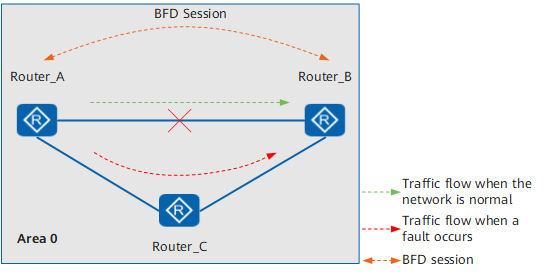
As shown in Figure 1, OSPFv3 runs among Router_A, Router_B, and Router_C which are mutual neighbors. The link from Router_A to Router_B serves as the active link whereas the link from Router_A to Router_C to Router_B serves as the standby link.
Create a BFD session on the link between Router_A and Router_B. Therefore, when the link status changes, the convergence speed of OSPFv3 increases. If the link between Router_A and Router_B fails, BFD rapidly identifies the fault and notifies OSPFv3 of the fault. Therefore, the service traffic is switched to the standby link.