Overview of DS-Lite
This section describes basic concepts about DS-Lite.
The fundamental driving force for IPv6 evolution is the lack of IPv4 address. Therefore, we need to take the following points into consideration when developing the IPv6 technology:
- How to introduce IPv6?
- How to balance the provision of IPv4 and not relying too much on it?
There are many IPv6 evolution solutions, such as Dual Stack (DS)+NAT44/NAT444, DS-Lite, 6RD, and NAT64. The solution to be adopted depends on carriers and the IPv6 evolution policy. The industry common sense is that DS-Lite is the final choice for IPv6 evolution. Because DS-Lite can provide both IPv4 and IPv6 services on the IPv6 network, and also can provide the IPv6 service alone. With the IPv6 service becoming dominant, the IPv4 service will gradually become an island. The DS-Lite architecture caters to future development and will become the final choice for IPv6 evolution.
DS-Lite is short for Dual-Stack Lite. Normally dual stack solutions require that the nodes aware of IP addresses must have and enable the dual stack capability. DS-Lite uses local dual stack. In other words, the DS-Lite technology can provide dual stacks to connect islands in the IPv6 network.
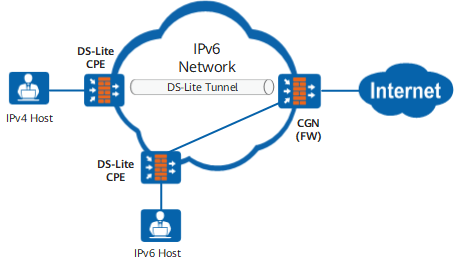
| CPE: Customer Premises Equipment | CGN: Carrier Grade NAT |
Figure 1 shows the typical networking of DS-Lite. Both IPv4 and IPv6 services are involved in this networking. The IPv6 service is transmitted through the IPv6 network, while the IPv4 service uses the following two technologies, which are also our main focuses:
IPv4 over IPv6 tunnel
The network between the CPE and CGN is a single-stack IPv6 network. If a home user wants to use the IPv4 service, packets need to be transmitted in the IPv4 over IPv6 tunnel. The IPv4 over IPv6 tunnel connects the CPE and CGN and uses IPv6 headers to encapsulate IPv4 packets for forwarding in the single-stack IPv6 network.
NAT policy
The home user obtains a private IPv4 address. Therefore, the CGN at the end of the IPv4 over IPv6 tunnel translates the private IPv4 address into a public IPv4 address.