Overview of NAT444
This section describes the NAT444 mechanism.
IPv4 addresses are to be exhausted. It is an inevitable trend to introduce IPv6 evolution. However, carriers' networks, business platforms, and terminals cannot support IPv6 commercially and comprehensively upon IPv4 exhaustion. During IPv4-to-IPv6 transition, Carrier Grade NAT (CGN) is introduced to prolong the use of IPv4 and leave more time for IPv6 deployment, which is the main function and purpose of NAT444.
NAT44 is traditional IPv4 NAT, translating private IPv4 addresses to public addresses, which is one translation. The main concept of NAT444 is to raise the NAT44 deployment position. Three address spaces (for the private user address, private carrier address, and public address) are formed by carrier-grade NAT44 device (CGN) deployed by carriers and NAT deployed at user side. This is also the origin of NAT444. NAT444 can increase the reuse rate of IPv4 addresses to ease address exhaustion. It is easy to deploy NAT444, requiring only adding the CGN device at the aggregation layer or core layer without large-scale device replacement.
Figure 1 shows the NAT444 processing procedure. Two-level NAT is implemented on the Customer Premise Equipment (CPE) and CGN devices.
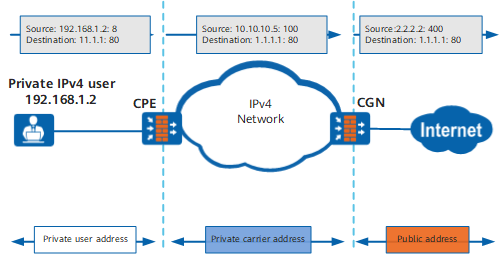
- When a private IPv4 network user tries to access the IPv4 Internet, the user first sends an IPv4 packet to the gateway device CPE.
- After receiving the private IPv4 packet, the CPE device translates the private address at the user side to a carrier's private address. Then the packet after NAT is forwarded to the CGN device according to the routing table.
- After receiving the packet, the CGN device translates the private address to a public IPv4 address. The packet is finally sent to the IPv4 destination on the Internet.