Understanding Debugs
This section describes the debug mechanism.
The FW outputs debugging information through the information center. The information center is an information hub of system software modules on the FW. You can sort output system information in a refined manner to effectively filter information.

Information Output
10 information channels are defined for the information center to control information output in different directions. These channels are independent of each other. You can configure debugging information output rules as required to allow information of different levels to be output through different channels, as shown in Figure 1.
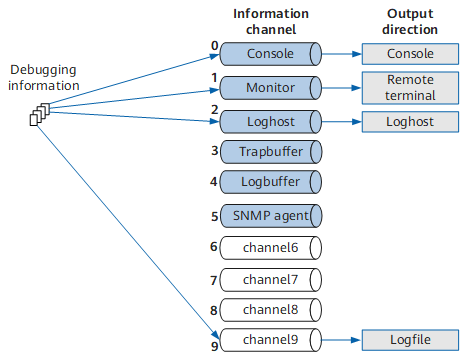
Table 1 shows the relationships between information channels and output directions.
Channel ID |
Default Channel Name |
Output Direction |
Description |
|---|---|---|---|
0 |
console |
console |
The console can receive logs, alarms, and debugging information. |
1 |
monitor |
monitor |
VTY terminals can receive logs, alarms, and debugging information, facilitating remote maintenance. |
2 |
loghost |
loghost |
Log hosts can receive logs, alarms, and debugging information. Information is stored in files on the log hosts. You can view the files at any time. |
3 |
trapbuffer |
trapbuffer |
The trap buffer can receive alarms. |
4 |
logbuffer |
logbuffer |
The log buffer can receive logs. |
5 |
snmpagent |
snmpagent |
The SNMP agent can receive alarms. |
6 |
channel6 |
Not specified |
This channel is reserved. You can specify the output direction. |
7 |
channel7 |
Not specified |
This channel is reserved. You can specify the output direction. |
8 |
channel8 |
Not specified |
This channel is reserved. You can specify the output direction. |
9 |
channel9 |
logfile |
Log files can receive logs, alarms, and debugging information. Information is stored in files in the storage media (SD or CF card) of the device |
If multiple log hosts are configured, you can configure the device to output debugging information through one or more channels to log hosts. For example, configure the device to output some debugging information to log hosts through channel 2 (loghost) and the rest debugging information to log hosts through channel 6. You can rename channel 6 to facilitate information channel management.
Debugging Functions
The output of debugging information depends on the following situations:
Whether debugging information about a protocol is output
Whether terminal display is enabled, that is, whether to display the debugging information on the screen
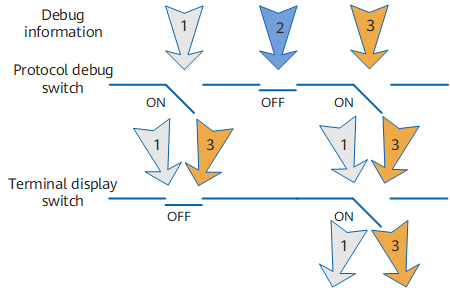
Figure 2 shows the relationship between the preceding two situations. After the debugging of protocol 1 and 3 is enabled, corresponding debugging information is output. As screen display is also enabled, the debugging information is displayed. No debugging information about protocol 2 is output because the debugging of protocol 2 is not enabled.