Overview of Deception
Once hackers or malware programs intrude into a network, they usually scan east-west traffic to learn about the network structure and service openness. The deception technology helps detect threats in a timely manner. By responding to the requests of scanning offline IP addresses and unopened ports, this technology can deceive hackers to access a Decoy for in-depth interaction to understand their intentions and protect the service network.
Intranet Security Threats and Countermeasures
After a hacker intrudes into a network, the first step is usually to scan IP addresses and service ports on the network to identify attack or infection targets. Then, the hacker exploits system or software vulnerabilities to attack the targets by means of brute-force cracking or other methods.
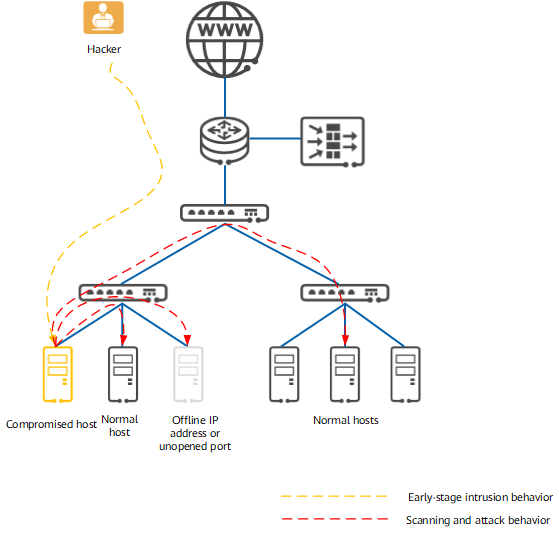
The deception technology can be used to detect and defend against this behavior based on its characteristics. Figure 2 uses deception against attacks targeting nonexistent IP addresses and unopened ports as an example to show how to deceive and dispose of intranet threats. For details about the deception function, see DecoySensor Functions.
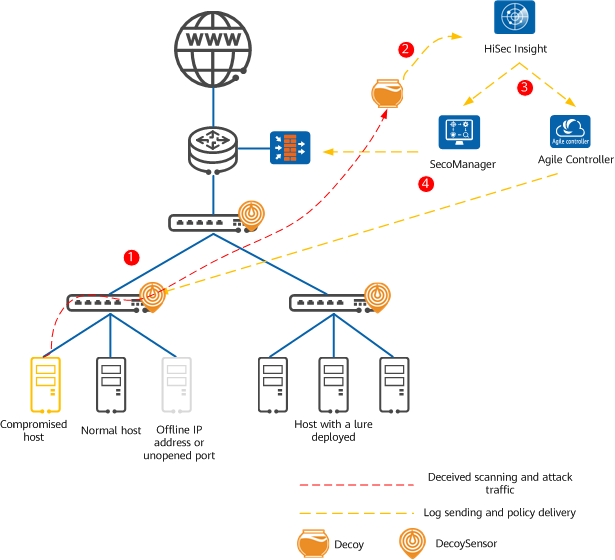
- A hacker scans IP addresses and ports. The DecoySensor detects the scanning behavior, responds to the scanning requests for offline IP addresses and unopened ports, and deceives suspicious traffic to the Decoy for further check.
- The hacker performs in-depth interaction with the Decoy. The Decoy records various application-layer attack methods of the hacker and reports the logs to the HiSec Insight collector.
- The HiSec Insight analyzes the reported logs. If the HiSec Insight determines that an attack occurs, it generates an alarm and provides handling suggestions. Upon confirmation by the administrator, the HiSec Insight delivers the association policy to the SecoManager or Agile Controller.
- The SecoManager or Agile Controller delivers the association command to the corresponding firewall or switch to cut off the connection with the attack source, protecting network services.
This part focuses on steps 1 and 2. Steps 3 and 4 involve the security association feature of the HiSec solution, which is not described here.
Deception Process and Components
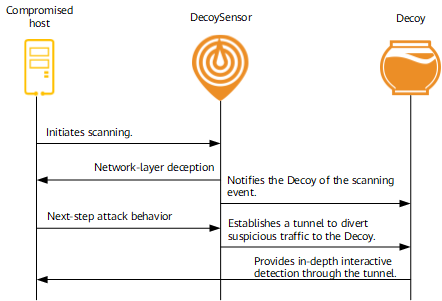
The main functions of the deception system are to identify scanning behavior and lure suspicious traffic to the Decoy. The Decoy deeply interacts with the traffic source to further determine whether the behavior constitutes an attack.
The DecoySensor is responsible for scanning detection, network-layer deception, and traffic diversion. The Decoy provides in-depth interaction and behavior analysis. The lure is deployed in real hosts to assist in deception.
Figure 3 show the deception process of the deception system. Table 1 shows the components of the deception system.
Component Name |
Main Function |
Deployment Mode |
|---|---|---|
DecoySensor |
|
DecoySensors can run on S series switches (for the models that support DecoySensors, see the switch product documentation), hardware firewalls (for the models that support DecoySensors, see the Limitations and Precautions for Deception), and software firewalls. No extra software is required. You only need to configure DecoySensors by running commands. Deployment requirements vary with scanned objects:
|
Decoy |
Provides the SSH,HTTP,SMB,FTP,RDP,MYSQL,REDIS,MEMCACHE,SQLSERVER,MongoDB service for in-depth interaction with hackers, analyzes hacker behaviors, and identifies attack tools. |
A third-party security device is called MoreSec Decoy. |