Typical Networking of a DecoySensor
The deployment position of a DecoySensor determines which deception functions are supported and the attack paths that can be defended against.
A DecoySensor can be a firewall or a switch. It can be flexibly combined with existing devices based on user requirements.
This section describes the networking scenarios related to DecoySensor functions. Ensure that the Decoy is reachable to the DecoySensor network.
Networking Scenarios
A DecoySensor needs to be aware of IP address scanning and port scanning. Therefore, it is recommended that the DecoySensor be deployed close to the user server. To achieve so, when the switch is used as a DecoySensor, S-series switches are recommended for deployment on the entire network.
If the switches on the network do not support the deception function, you can deploy a software firewall or dedicated deception firewalls to detect scanning.
Networking Scenario |
Networking Diagram |
Description |
|---|---|---|
A firewall is connected to the core switch in bypass mode as a DecoySensor. |
|
Advantages:
Disadvantages:
|
A firewall is connected to the access or aggregation switch in bypass mode as a DecoySensor. |
|
Advantages:
Disadvantages:
|
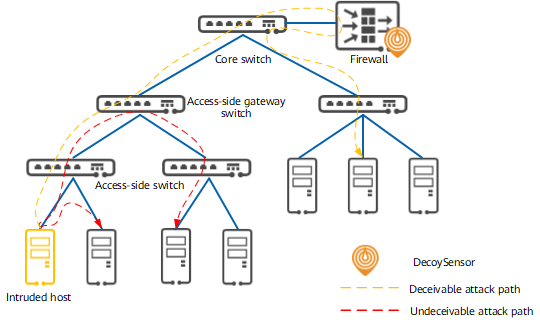
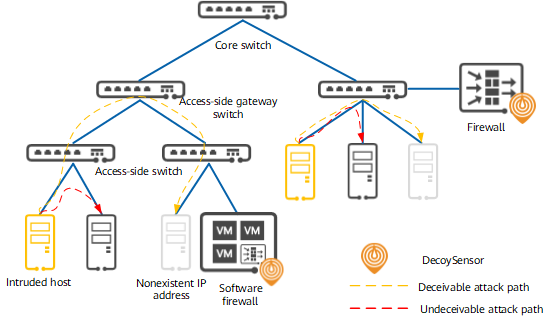
Relationship Between the Networking and Deception Functions
To use the deception function for IP address scanning, a DecoySensor need to have a Layer 3 IP address in the service subnet. To use the deception function for SYN packet scanning, both scanning packets and response packets need to pass through the same DecoySensor. Therefore, the networking is closely related to deception functions.
Deception Function |
A firewall is connected to the core switch in bypass mode as a DecoySensor |
A firewall is connected to the access or aggregation switch in bypass mode as a DecoySensor |
|---|---|---|
Deception against attacks targeting specific static IP addresses |
Applicable |
Applicable |
Deception against attacks targeting specific static ports |
Applicable |
Not applicable |
Deception against attacks targeting nonexistent IP addresses |
Not applicable |
Applicable |
Deception against attacks targeting unopened ports |
Applicable |
Not applicable |
Route-Miss deception |
Applicable |
Not applicable |
ARP-Miss deception |
Not applicable |
Not applicable |
Security-policy-deny deception |
Applicable |
Not applicable |
Deception against unknown domain name attacks |
Applicable |
Not applicable |
ACI deception |
Applicable |
Not applicable |