Overview of Hardware Fast Forwarding
This section describes the basic concepts of hardware fast forwarding.
Generally, after receiving a packet, the FW sends the packet to the CPU for processing. After processing the packet, the CPU sends the packet to the specified outbound interface.
To reduce the CPU load and improve the device's service processing performance, the FW supports fast forwarding for certain services. For subsequent packets that meet the fast forwarding conditions, the fast-forwards the packets through hardware acceleration without sending them to the CPU.
Figure 1 shows the packet processing flow on the FW when the hardware fast forwarding function is enabled.
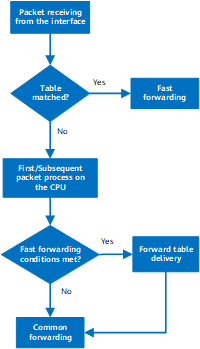
- After receiving a packet, the FW determines whether the packet matches the corresponding fast forwarding table. The fast forwarding table can be considered as a compact version of the session table and is used to process packets.
- If the packet matches the fast forwarding table, the fast-forwards the packet according to the table information without sending it to the CPU for processing. If the packet does not match the fast forwarding table, the sends the packet to the CPU for a normal first packet/subsequent packet process.
- The CPU checks whether the packet meets the fast forwarding conditions. If yes, the CPU delivers the corresponding flow table to the acceleration hardware according to the session table and performs common processing and forwarding on the packet; if no, the device performs common processing and forwarding.