Understanding Interworking Between Hot Standby and Dynamic Routes
Before configuring interworking between hot standby and OSPF/BGP, familiarize yourself with the implementation principles.
As shown in Figure 1, two FWs form the hot standby networking. The service interfaces of the FWs work at Layer 3, and the FWs connect to routers in the upstream direction. OSPF runs between the FWs and routers. When the routing protocol goes Down on the network link where GE0/0/1 on FW_A resides, if the physical state of GE0/0/1 is still Up, the hrp track interface GigabitEthernet 0/0/1 fault detection mode cannot trigger an active/standby switchover because hrp track interface monitors the physical status of the interface rather than the protocol status.
To enable the FW to detect OSPF dynamic route faults and trigger an active/standby switchover in a timely manner, you can use the VGMP group to monitor OSPF, the priority of the VGMP group changes with the neighbor status to trigger an active/standby switchover.
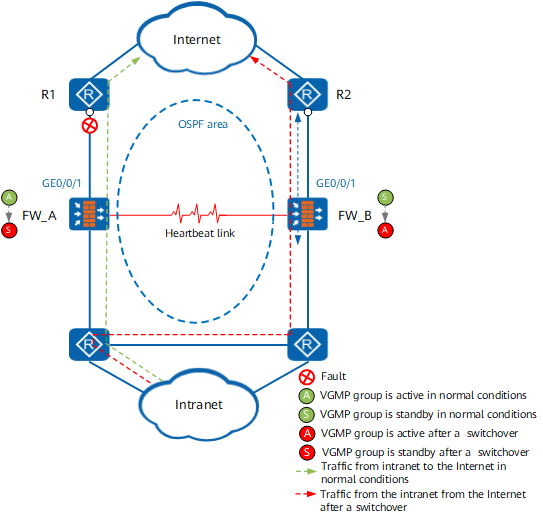
- After the VGMP group is configured to monitor the OSPF neighbor status, the VGMP group priority reduces by 2 when the OSPF neighbor state changes from Full to another state, triggering an active/standby switchover. When the OSPF neighbor state changes to Full, the VGMP group priority increases by 2.
- After the VGMP group is configured to monitor the BGP peer status, the VGMP group priority reduces by 2 when the BGP peer state changes from Established to another state, triggering an active/standby switchover. When the BGP peer state changes to Established, the VGMP group priority increases by 2.
- The function of the VGMP group monitoring the OSPF neighbor or BGP peer status is supported in non-mirroring mode.
- On a broadcast network, two routers whose interface state is DROther do not form a neighbor relationship and stay in the 2-way state. An active/standby switchover will be triggered when the FW detects that the OSPF neighbor state is not Full (including 2-way). Therefore, when the state of the interface connecting the FW to the neighbor is DROther, the monitored neighbor router cannot be DROther.
- As intermittent disconnection may cause neighbor relationship flapping and each neighbor relationship change will trigger an active/standby FW switchover, to prevent repeated switchovers, you are advised to run the undo hrp preempt command to disable the preemption function.
- Link faults or topology changes may cause the routers to recalculate routes. To improve network availability, the convergence time of routing protocols must be shortened. Therefore, when configuring a VGMP group to monitor the routing neighbor status, you are advised to associate BFD with OSPF/BGP, so that BFD can rapidly detect link faults and notify the dynamic routing protocol of the faults, speeding up BGP's response to network topology changes. In this way, the active/standby switchover is accelerated, and the impact on services is reduced.