ISATAP Tunnel
Defined in RFC4214 as an IPv6 automatic tunnel, the Intra-Site Automatic Tunnel Addressing Protocol (ISATAP) tunnel is used by the dual-stack host on an IPv4 network to access the IPv6 network.
ISATAP supports automatic address configuration, and the ND protocol can be enabled on the devices at both ends of the ISATAP tunnel. After an ISATAP tunnel is configured, the IPv6 network regards the IPv4 network at the bottom as a non-broadcast multiple access (NBMA) link.
ISATAP Address Format
Similar to the 6to4 address, an IPv4 address is embedded in the ISATAP address and implements tunnel encapsulation. However, the ISATAP address and the 6to4 address have different formats. The IPv4 address serves as the network ID of the 6to4 address and the interface ID of the ISATAP address. The interface ID is constructed by revised EUI-64, as shown in Figure 1.

- If the IPv4 address is globally unique, the u bit is 1. Otherwise, it is 0. The ISATAP tunnel is typically used inside the site. Therefore, the embedded IPv4 address does not need to be globally unique.
- The g bit is an Institute of Electrical and Electronic Engineers (IEEE) group or individual ID. It is fixed to 0.
The first 16 bits of the interface ID in an ISATAP address can be 0000, and the following 16 bits (fixed to 5EFE) are assigned by the Internet Assigned Numbers Authority (IANA). Therefore the interface ID of the ISATAP address can be expressed as 0000:5EFE:IPv4-Address.
The first 64 bits (network ID) of the ISATAP address are requested from the ISATAP routing device. Therefore, the entire ISATAP address is Prefix(64bit)::5EFE:IPv4-Address.
ISATAP Tunnel
Because the dual-stack host and the ISATAP routing device reside on the same IPv4 network, set the IPv4 address embedded in the ISATAP address to either a public address or a private address when you create an ISATAP tunnel.
As shown in Figure 2, the dual-stack host obtains an IPv6 address in the following way:
Host A sends a routing device request message.
Host A sends a routing device request message to the ISATAP routing device using the link-local address in ISATAP format. The request message is encapsulated in an IPv4 packet.
The ISATAP routing device responds to the request.
The ISATAP routing device replies to the routing device request with a routing device advertisement message, which contains the ISATAP prefix (specified manually on the routing device).
Host A obtains its IPv6 address.
Host A obtains its IPv6 address by combining the ISATAP prefix with 5EFE:IPv4-Address and uses this address to access the IPv6 network.
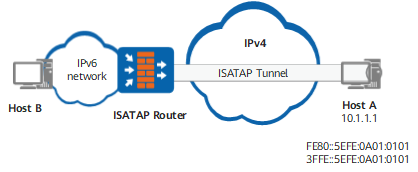
When host A accesses host B, the procedures are as follows:
- Host A on an IPv4 network obtains its IPv6 address by following the preceding steps.
- Host A sends a packet to access IPv6 hosts on an IPv6 network. The packet is encapsulated into an IPv4 packet.
- The ISATAP routing device receives this IPv4 packet, decapsulates it, and sends the IPv6 packet to host B on the IPv6 network.