Establishing LSPs
Procedure
MPLS assigns packets to a FEC, distributes labels that identify the FEC, and establishes an LSP. Packets travel along the LSP.
Labels are assigned and distributed by a downstream LSR to an upstream LSR. As shown in Figure 1, packets destined for 3.3.3.3 are assigned to a FEC. Downstream LSRs assign labels for the FEC to upstream LSRs and use a label advertisement protocol to inform the upstream LSRs of the mapping between the labels and FEC. Each upstream LSR adds the mapping to a label forwarding table. An LSP is established using the label mapping information.
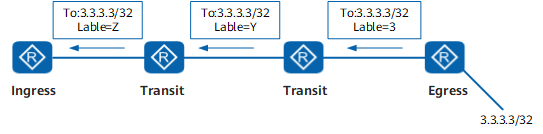
LSPs can be either static or dynamic. Static LSPs are established manually. Dynamic LSPs are established using a routing protocol and a label distribution protocol.
Establishing Static LSPs
You can manually allocate labels to set up static LSPs. The outgoing label value of the upstream node is equal to the incoming label value of the downstream node.
A static LSP is meaningful only to the local node, and the local node that cannot monitor the entire LSP.
On the ingress: A static LSP is configured over a route, and the outbound interface is enabled with MPLS. If the route is reachable, the static LSP goes Up, regardless of the existence of the transit node or egress. A reachable route means that a route entry exists and its destination address and next hop address match those in the local routing table.
On the transit node: A static LSP is configured, and the inbound and outbound interfaces are enabled with MPLS. If the inbound and outbound interfaces are Up on the physical and protocol layers, the static LSP can go Up, regardless of the existence of the ingress, egress, or other transit nodes.
On the egress: A static LSP is configured, and the inbound interface is enabled with MPLS. If the inbound interface is Up on the physical and protocol layers, the static LSP goes Up, regardless of the existence of the ingress or transit node.

A reachable route is only required on the ingress for setting up a static LSP, but not on the transit node or egress.
A static LSP is set up without label distribution protocols or the exchanging of control packets. The static LSP has a low cost and is recommended for small-scale networks with simple and stable topology. The static LSP cannot vary dynamically with the network topology. Instead, it needs to be configured by an administrator.
Establishing Dynamic LSPs
Dynamic LSPs are set up automatically by one of the following label distribution protocols:
Label Distribution Protocol (LDP)
LDP is specially defined to distribute labels. When LDP sets up an LSP in hop-by-hop mode, LDP identifies a next hop based on the routing forwarding table on each LSR. Information contained in the routing forwarding table is collected by Interior Gateway Protocol (IGP) and BGP. LDP only uses routing information, but is not associated with the routing protocols.
In addition to LDP, BGP and RSVP can also be extended to distribute MPLS labels.
Multiprotocol Extension for BGP (MP-BGP)
TMP-BGP is an extension to BGP. MP-BGP defines community attributes. MP-BGP supports label distribution for packets transmitted over MPLS virtual private network (VPN) routes and labeled inter-AS VPN routes.