LDP Extension for Inter-Area LSP
In a large-scale network, multiple IGP areas usually need to be configured for flexible network deployment and fast route convergence. When advertising routes between IGP areas, to prevent a large number of routes from consuming too many resources, an area border router (ABR) needs to aggregate the routes in the area and then advertise the aggregated route to the neighbor IGP areas. The LDP extension for inter-area LSP function supports the longest match rule for looking up routes so that LDP can use aggregated routes to establish inter-area LDP LSPs.
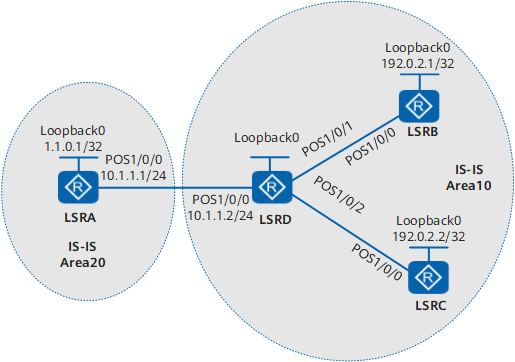
As shown in Figure 1, there are two IGP areas: Area 10 and Area 20.
Therefore, in the situation shown in Figure 1, configure LDP to search for routes based on the longest match rule for establishing LSPs. There is already an aggregated route to 192.0.2.0/24 in the routing table of LSRA. When LSRA receives a Label Mapping message (such as the carried FEC is 192.0.2.1/32) from Area 10, LSRA searches for a route according to the longest match rule defined in RFC 5283. Then, LSRA finds information about the aggregated route to 1.3.0.0/24, and uses the outbound interface and next hop of this route as those of the route to 192.0.2.1/32. LDP can establish inter-area LDP LSPs.