Overview of BGP/MPLS IP VPN
BGP/MPLS IP VPN is a PE-based L3VPN technology used in the Provider Provisioned VPN (PPVPN) solution. BGP/MPLS IP VPN uses BGP to advertise VPN routes and MPLS to forward VPN packets on the provider's backbone network.
Definition
A BGP/MPLS IP VPN is a Layer 3 Virtual Private Network (L3VPN). A BGP/MPLS IP VPN uses the Border Gateway Protocol (BGP) to advertise VPN routes and the Multiprotocol Label Switching (MPLS) to forward VPN packets on backbone networks. IP means that IP packets are carried by the VPN.
Figure 1 shows the basic model of a BGP/MPLS IP VPN.
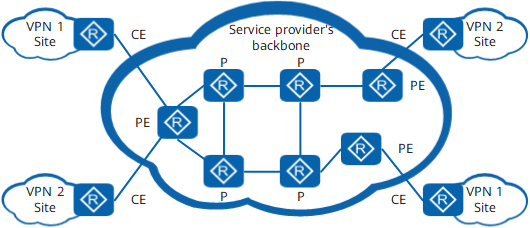
The BGP/MPLS IP VPN model consists of the following parts:
Customer Edge (CE): It is an edge device on a customer network, providing interfaces that are directly connected to the Service Provider (SP) network. A CE can be a router, a switch, or a host. Usually, a CE neither senses the VPN nor supports MPLS.
Provider Edge (PE): It is an edge device on an SP network. A PE is directly connected to the CE. On an MPLS network, PEs process all VPN services. Therefore, the requirements on the performance of PEs are rather high.
Provider (P): It is a backbone device on an SP network. A P is not directly connected to CEs. Ps only need to possess basic MPLS forwarding capabilities and do not maintain information about a VPN.
PEs and Ps are managed by SPs. CEs are managed by users except that the users trust SPs with the management right.
A PE can access multiple CEs. A CE can be connected to multiple PEs of the same SP or of different SPs.
Objective
MPLS seamlessly integrates the flexibility of IP routing and simplicity of Asynchronous Transfer Mode (ATM) label switching. A connection-oriented control plane is introduced into an MPLS IP network, which enriches the means of managing and operating the network. On IP networks, MPLS traffic engineering (TE) has become an important tool in managing network traffic, reducing network congestion, and ensuring Quality of Service (QoS).
Therefore, the VPNs or MPLS VPNs using MPLS IP networks as the backbone networks are highly evaluated by carriers, and become an important means of providing value-added services.
Unlike the Interior Gateway Protocol (IGP), BGP focuses on controlling route transmission and choosing the optimal routes instead of discovering and calculating routes. VPNs use public networks to transmit VPN data, and the public networks use IGP to discover and calculate their routes. The key to constructing a VPN is controlling the transmission of VPN routes and choosing the optimal routes between two PEs.
BGP uses the Transport Control Protocol (TCP) with the port number being 179 as the transport layer protocol. The reliability of BGP is therefore enhanced. Therefore, VPN routes can be directly exchanged between two PEs with devices locating between them.
BGP can carry any information appended to a route. As the optional BGP attributes, the information is transparently forwarded by BGP devices that cannot identify those attributes. Therefore, VPN routes can be conveniently transmitted between PEs.
When routes are updated, BGP sends only updated routes rather than all routes. This saves the bandwidth consumed by route transmission. The transmission of a great number of routes over a public network therefore becomes possible.
As an Exterior Gateway Protocol (EGP), BGP is suitable for VPNs that span more than one carrier network.