Overview of IP Multicast
This section describes the background of multicast, multicast advantages, and actual multicast applications. Multicast implements efficient point-to-multipoint (P2MP) data transmission on IP networks. It saves network bandwidth and reduces network loads. Multicast is widely used in IPTV, real-time data transmission, and multimedia conferences services.
Background
Traditional IP communication has two modes: unicast and broadcast. In unicast mode, a source IP host sends data to only one destination IP host. In broadcast mode, a source IP host sends data to all IP hosts on its own network.
If a source IP host needs to send data to only several specified destination IP hosts but not all hosts, the source IP host broadcasts data or unicasts a copy of data to each destination IP host, as shown in Figure 1.
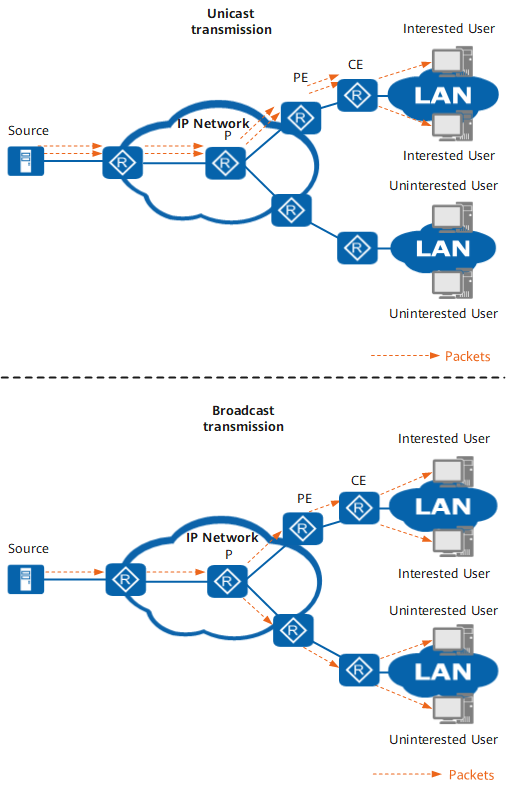
- In unicast transmission, the volume of data to be transmitted is in direct proportion to the number of users requiring the data. If a great number of users requiring the data, the data source must send the same data to each user, which burdens the data source and exhausts the bandwidth of the link from the data source to a Customer Edge (CE) device. Unicast transmission has a defect in batch data transmission.
- In broadcast transmission, hosts that have no interest in data can still receive the data. This degrades data security and generates a high volume of traffic from the data P to the CE device. Broadcast transmission has a defect in exchanging data with a specified host and wastes network bandwidth.
Unicast and broadcast modes both cannot efficiently implement P2MP data transmission.
Multicast Advantages
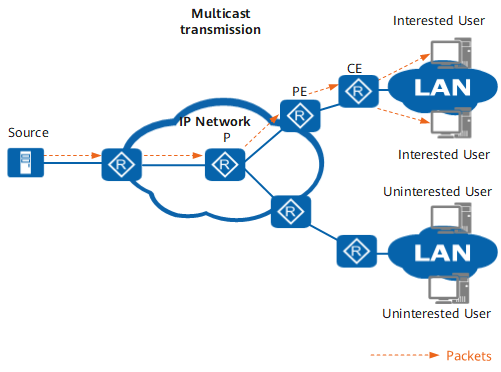
In multicast mode, specific receivers do not need to be designated in advance and data is not distributed to all hosts on the network. Compared with unicast and broadcast, multicast has the following advantages:
- Compared with unicast, multicast copies and distributes data at a branch as far from the data source as possible. Therefore, the increase in the number of users will not burden the data source nor exhaust network resources.
- Compared with broadcast, multicast sends data to only the receivers interested in the data. It saves network resource and improves data transmission security. In addition, broadcast implements data transmission only on the same network segment, whereas multicast can implement data transmission crossing different network segments.
Applications
The multicast technology provides a solution to efficient P2MP data transmission on networks. It saves a large amount of bandwidth resources and reduces network loads. Moreover, multicast provides new value-added services, such as live broadcasting, IPTV, e-learning, telemedicine, network radio, and real-time video and audio conferences to help people communicate and enrich their lives.