Overview of PIM-DM
In the network where multicast group members are densely distributed and each network segment may have multicast group members, Protocol Independent Multicast-Dense Mode (PIM-DM) builds a unidirectional and loop-free shortest path tree (SPT) from the multicast source to the group member through periodical flooding and pruning.

This chapter is concerned only about the PIM-DM configuration in an IPv4 network.
The Protocol Independent Multicast (PIM) is a multicast protocol that is independent of unicast routing protocol such as static route, RIP, OSPF, IS-IS, and BGP. Multicast routing is independent of unicast routing protocols, except that unicast routing protocols are used to generate related multicast routing entries.
Based on the Reverse Path Forwarding (RPF), PIM transmits multicast data across a network. RPF constructs a multicast forwarding tree by using the existing unicast routing information. When a multicast packet reaches a FW, the FW performs the RPF check first. If the packet does not pass the RPF check, the FW directly discards the packet.
The PIM-DM is applicable to a small-scale network with densely-distributed members.
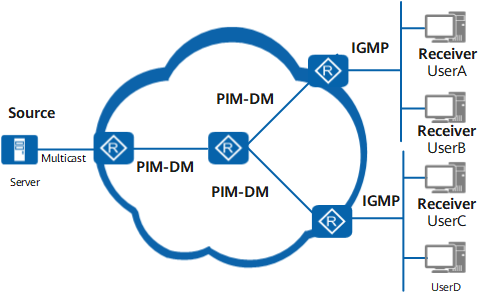
The functions and location of PIM-DM in a multicast network are shown in Figure 1.
The Protocol Independent Multicast-Sparse Mode (PIM-SM) is applicable to a large-scale network with sparsely-distributed members. For details about PIM-SM, see PIM-SM (IPv4) Configuration.