Overview of PIM-SM
In a PIM-SM network, group members are sparsely distributed and almost all the network segments do not have group members resided. Therefore, a Rendezvous Point (RP) is a forwarding core of the PIM-SM network. All PIM devices in the PIM-SM network must know the location of the RP and the RP collects information about both group members and multicast sources.
The Protocol Independent Multicast (PIM) indicates that any unicast routing protocol, such as static route, RIP, OSPF, IS-IS, or BGP, can provide the routing information for IP multicast. Multicast routing is independent of unicast routing protocols, except that the unicast routing table is used to generated multicast routing entries.
PIM forwards multicast packets by using the Reverse Path Forwarding (RPF) mechanism. The RPF mechanism is used to create the multicast forwarding tree through the existing unicast routing information. When a multicast packet arrives at a router, the router performs the RPF check on the packet. If the RPF check succeeds, a multicast routing entry is created for forwarding the multicast packet. If the RPF check fails, the packet is discarded.
The working process of the Protocol Independent Multicast-Sparse Mode (PIM-SM) consists of neighbor discovery, assert, DR election, RP discovery, join, prune, register, and SPT switchover.
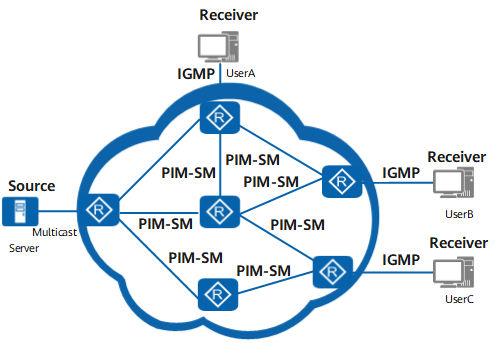
As shown in Figure 1, PIM-SM is used in a large-scale network with sparsely distributed group members.

The Protocol Independent Multicast Dense Mode (PIM-DM) is applicable to a small-scale network with densely distributed members.
PIM-SM can be used to construct the Any-Source Multicast (ASM) and Source-Specific Multicast (SSM) models.