Multicast Load Splitting
This section describes the multicast load splitting policies and their implementation mechanisms.
Multicast group-based load splitting
Multicast group-based load splitting mainly applies to a large number of multicast groups that exist on the network.
Multicast source-based load splitting
Multicast source-based load splitting applies to a large number of multicast sources that exist over the network.
Multicast source and group-based load splitting
Multicast source- and multicast group-based load splitting mainly applies to t a large number of multicast sources and groups that exist over the network.
Stable-preferred load splitting
Stable-preferred load splitting mainly applies to the preceding multicast load splitting policies. It can also be applied to a shared network segment.
Balance-preferred load splitting
The scenarios for balance-preferred load splitting are the same as those for stable-preferred load splitting.
Multicast Group-based Load Splitting
Figure 1 shows the networking diagram of multicast group-based load splitting.
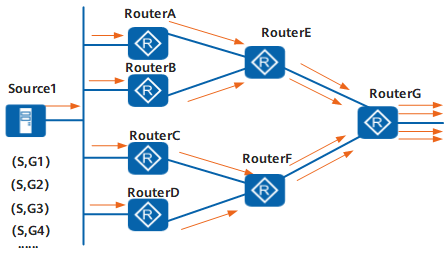
Based on a series of algorithms, a multicast router can select an appropriate route among several equal-cost routes for each multicast group. This route is used for packet forwarding for this group. Finally, multicast traffic for different groups can be split into different forwarding paths.
Multicast Source-based Load Splitting
Figure 2 shows the networking diagram of multicast source-based load splitting.
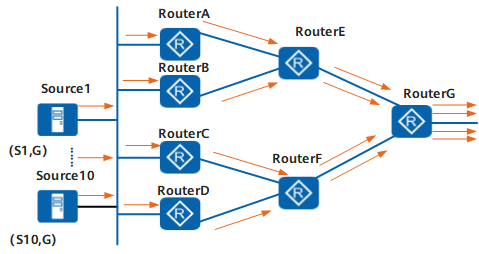
Based on a series of algorithms, a multicast FW can select an appropriate route among several equal-cost routes for each multicast source. This route is used for packet forwarding for this source. Finally, multicast traffic from different sources can be split into different forwarding paths.
Multicast Source- and Multicast Group-based Load Splitting
Figure 3 shows the networking diagram of multicast source- and multicast group-based load splitting.
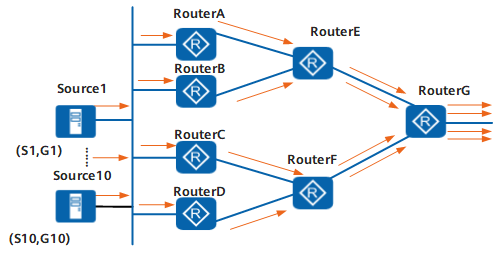
Based on a series of algorithms, a multicast router can select an appropriate route among several equal-cost routes for each source-specific multicast group. This route is used for packet forwarding for this source-specific multicast group. Finally, multicast traffic for different source-specific groups can be split into different forwarding paths.
Stable-preferred Load Splitting
Applicable environment
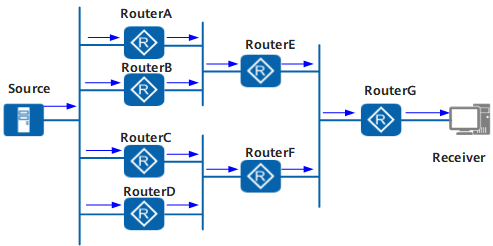
In addition to the scenarios for the preceding multicast load splitting policies shown in Figure 1, Figure 2, and Figure 3, stable-preferred load splitting can also be applied to a shared network segment, as shown in Figure 4.
Implementation principle
The router configured with stable-preferred load splitting selects the most appropriate route for a newly created entry, that is, the route assigned the fewest entries. When the network topology and entries are stable, all entries with the sources on the same network segment are distributed evenly among the equal-cost routes.
If unbalance is caused because an entry is deleted or the weight of a route changes, the router configured with stable-preferred load splitting solves the problem by selecting the most appropriate routes for subsequent entries.
In stable-preferred load splitting mode, if finding that entries are not balanced among paths, the device will balance entries after a certain time (a waiting time) to reduce the impact of frequent entry changes on the system.
Currently, setting a load splitting timer to change the waiting time before balancing entries is supported.
Balance-preferred Load Splitting
The router configured with balance-preferred load splitting selects the most appropriate route for a newly created entry, that is, the route assigned the fewest entries. Balance-preferred load splitting always balances the entries with sources on the same network segment among the equal-cost routes. This balancing occurs even if entries are deleted, the weights of outgoing interfaces change, or the number of equal-cost routes changes. When the entries are unbalanced, there is a delay for the router enabled with balance-preferred load splitting to balance the entries, which prevents the frequent changes of routes for the entries. In addition, within the delay, the router can balance the entries by selecting the most appropriate routes for subsequent entries.
Currently, setting a load splitting timer to change the waiting time before balancing entries is supported.
Unbalanced Load Splitting
Applicable environment
Unbalanced load splitting complements stable-preferred load splitting and balance-preferred load splitting, but does not change the basic behavior of the two policies. Instead, unbalanced load splitting distributes the entries on the equal-cost routes in a certain proportion. Unbalanced load splitting is applied to the scenarios of the preceding two types of load splitting. The exception is shown in Figure 4. Typical scenarios of unbalanced load splitting are as follows:When the forwarding capabilities of several equal-cost routes are different or the severities of traffic congestion on the equal-cost routes are different, unbalanced load splitting can be configured to adjust the entries distributed to the equal-cost routes. In this case, the route, the weight of whose outgoing interface is higher, is assigned more entries. Stable-preferred load splitting is valid to only the subsequent entries whereas balance-preferred load splitting adjusts the existing entries based on the weights of the equal-costs routes.
When a router on the path of an equal-cost route of the router configured with unbalanced load splitting needs to be upgraded, the weight of the outgoing interface of the equal-cost router can be set to 0 so that the traffic of the entries on the equal-cost route can be switched to other equal-cost routes. This scenario applies when balance-preferred load splitting is configured.
Implementation principle
The unicast equal-cost routes are different in terms of the forwarding capability, network load, and link use. Therefore, it is difficult to implement balanced load splitting for multicast entries in a specific scenario. To solve this problem, unbalanced load splitting is introduced. Unbalanced load splitting allows users to set the weights of the equal-cost routes on the outgoing interfaces of the equal-cost routes. The route, the weight of whose outgoing interface is higher, is assigned more entries.