IP Addresses
This section describes the concepts and features related to IPv4 addresses and IPv6 addresses.
IPv4 Addresses
An IPv4 address consists of four binary octets separated by dots. Each octet can be expressed in a decimal number. For example, 10.0.0.1 is an IPv4 address.
IPv4 address classes
An IPv4 address consists of the following fields:
Network ID field: distinguishes a network from each other. The network ID is called a class field, and network ID bits are called class bits.
Host ID field: identifies a host on a network.
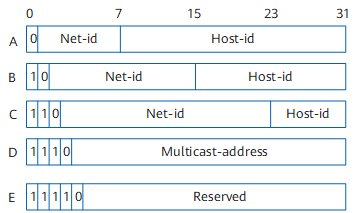
IPv4 addresses have five classes to facilitate address management and networking. Figure 1 shows classes of IPv4 addresses.
Most IPv4 addresses in use belong to class A, B, or C. Class D addresses are multicast addresses. Class E addresses are reserved. For more information, see RFC 1166 "Internet Numbers."
Some IPv4 addresses are reserved for special use. Table 1 lists the range of each class of IPv4 addresses.
Table 1 IPv4 address classes and ranges Network
Address Range
Available IPv4 Network Range
Description
Class A
0.0.0.0 to 127.255.255.255
1.0.0.0 to 126.255.255.0
Special class A IPv4 addresses are as follows:- IPv4 address with a host ID that is all 0s: a network address used for routing.
- IPv4 address with a host ID that is all 1s: a broadcast address used to send packets to all hosts on a network.
- 0.0.0.0: an ineffective destination address only used by a FW to send a Dynamic Host Configuration Protocol (DHCP) Discovery request.
- 127.0.0.0.0 to 127.255.255.255: reserved for loopback tests. A FW sends a packet with an address within this range to the FW itself and processes the packet without forwarding it.
Class B
128.0.0.0 to 191.255.255.255
128.0.0.0 to 191.255.255.0
Special class B IPv4 addresses are as follows:- IPv4 address with a host ID that is all 0s: a network address used for routing.
- IPv4 address with a host ID that is all 1s: a broadcast address used to send packets to all hosts on a network.
Class C
192.0.0.0 to 223.255.255.255
192.0.0.0 to 223.255.255.0
Special class C IPv4 addresses are as follows:- IPv4 address with a host ID that is all 0s: a network address used for routing.
- IPv4 address with a host ID that is all 1s: a broadcast address used to send packets to all hosts on a network.
Class D
224.0.0.0 to 239.255.255.255
None
Class D IPv4 addresses are multicast addresses.
Class E
240.0.0.0 to 255.255.255.255
None
Class E IPv4 addresses are reserved for future use. 255.255.255.255 is a LAN broadcast address.
Special IPv4 addresses
Some special IPv4 addresses exist in real-world situations. Table 2 lists special IPv4 addresses.
Table 2 Special IPv4 addresses Net ID
Subnet ID
Host ID
Used as a Source Address
Used as a Destination Address
Description
All 0s
-
0
Yes
No
Used by all hosts on a network.
All 0s
-
host-id
Yes
No
Used by specified hosts on a network.
127
-
Any value
Yes
Yes
Used as loopback addresses.
All 1s
-
All 1s
No
Yes
Used to broadcast packets but not to forward them.
net-id
-
All 1s
No
Yes
Used to broadcast packets to networks with specified net IDs.
net-id
subnet-id
All 1s
No
Yes
Used to broadcast packets to subnets with specified net and subnet IDs.
net-id
All 1s
All 1s
No
Yes
Used to broadcast packets to all subnets with specified net IDs.

net-id and subnet-id are non-0 values.
Private IPv4 addresses
To help alleviate the problem of exhausting IPv4 addresses, private networks and their hosts, not public networks, are assigned private IPv4 addresses. As defined in RFC 1918, the Internet Assigned Numbers Authority (IANA) has reserved three IPv4 address blocks for private networks.
Table 3 lists private network IPv4 addresses.
IPv4 Address Assignment
You can use one of the following methods to assign IPv4 addresses to interfaces:
Static IP
Specify IPv4 addresses for Layer-3 Ethernet interfaces and their subinterfaces, VLAN interfaces, Eth-Trunk interfaces, and loopback interfaces.
To defend against IP address spoofing, you need to configure the IP-MAC binding on the FW.
PPPoE
Configure PPPoE to perform PPP negotiation to obtain IPv4 addresses for Layer-3 Ethernet interfaces and their subinterfaces, VLAN interfaces, and Eth-Trunk interfaces.
Unnumbered IPv4 address mechanism
Use IP addresses of other interfaces as the IP addresses of tunnel and VT interfaces.
IPv6 Address Assignment
You can use one of the following methods to assign IPv4 addresses to interfaces:
Static IP
Specify IPv6 addresses for Layer-3 Ethernet interfaces and their subinterfaces, VLAN interfaces, Eth-Trunk interfaces, and loopback interfaces.
DHCP
Configure DHCP to automatically assign IPv6 addresses for Layer-3 Ethernet interfaces and their subinterfaces, VLAN interfaces, and Eth-Trunk interfaces.
PPPoE
Configure PPPoE to perform PPP negotiation to assign IPv6 addresses to Layer-3 Ethernet interfaces and their subinterfaces, VLAN interfaces, and Eth-Trunk interfaces.
Neighbor Discovery (ND) Router Advertisement (RA)
Configure stateless address autoconfiguration to enable interfaces to obtain IPv6 prefixes from RA messages. The interfaces then use IPv6 prefixes and local interface IDs to form EUI-64 IPv6 addresses.
The interfaces can be Layer-3 Ethernet interfaces or their subinterfaces, VLAN interfaces, or Eth-Trunk interfaces.