Overview of BGP
This section provides the definition and objective of BGP.
Definition
The Border Gateway Protocol (BGP) is a dynamic routing protocol used between autonomous systems (ASs).
BGP-1 (defined in RFC 1105), BGP-2 (defined in RFC 1163), and BGP-3 (defined in RFC 1267) are three earlier-released versions of BGP. BGP exchanges the reachable inter-AS routes, establishes inter-AS paths, avoids routing loops, and applies routing policies between ASs.
The current BGP version is BGP-4 defined by RFC 4271.
As an exterior routing protocol on the Internet, BGP is widely used among Internet Service Providers (ISPs).
BGP has the following characteristics:
- Different from the Interior Gateway Protocol (IGP) such as Open Shortest Path First (OSPF) and Routing Information Protocol (RIP), BGP is an Exterior Gateway Protocol (EGP), which controls the route advertisement and selects the optimal route between ASs rather than discover and calculate routes.
BGP uses the Transport Control Protocol (TCP) with the port number being 179 as the transport layer protocol. The reliability of BGP is thus enhanced.
- BGP selects inter-AS routes, which proposes high requirements on the reliability of the protocol. TCP with high reliability, therefore, is used to enhance the stability of BGP.
- BGP peers must be logically connected and establish TCP connections. The destination port number is 179 and the local port number is random.
- BGP supports Classless Inter-Domain Routing (CIDR).
- BGP transmits only the updated routes when routes are being updated. This reduces the bandwidth occupied by BGP for route distribution. Therefore, BGP is applicable to the Internet where a large number of routes are transmitted.
- BGP is a distance-vector routing protocol.
BGP is designed to avoid loops.
- Inter-AS: BGP routes carry information about the ASs along the path. The routes that carry the local AS number are discarded, thus avoiding inter-AS loops.
- Intra-AS: BGP does not advertise the routes learned in the AS to the BGP peers, thus avoiding intra-AS loops.
- BGP provides rich routing policies to flexibly select and filter routes.
- BGP provides the mechanism for preventing route flapping, which effectively enhances the stability of the Internet.
- BGP can be easily extended to adapt to the development of networks.
Objective
BGP transmits routes between ASs. It, however, is not required in all situations.
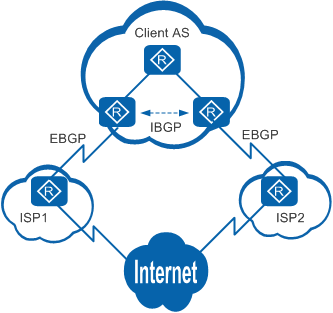
BGP is required in the following situations:
- As shown in Figure 1, the user needs to be connected to two or more ISPs. The ISPs need to provide all or part of the Internet routes for the user. The router, therefore, selects the optimal route through the AS of an ISP to the destination according to the AS_Path carried in BGP routes.
- Different organizations need to transmit the AS_Path.
- Users transmit private network routes through layer-3 VPN.
- Users need to transmit multicast routes to construct the multicast topology.
BGP is not required in the following situations:
- The user is connected to only one ISP.
- The ISP does not need to provide Internet routes for users.
- ASs are connected through default routes.