IS-IS LSP Fragment Extension
When the LSPs to be advertised by IS-IS contain much information, they are advertised in multiple LSP fragments of the same system. The IS-IS LSP fragment extension attribute allows an IS-IS router to generate more LSP fragments and carry more IS-IS information.
As defined in RFC 3786, virtual system IDs can be configured and virtual LSPs that carry routing information can be generated for IS-IS.
Terms
Originating system: is a router that runs the IS-IS protocol. A single IS-IS process can advertise its LSPs as multiple "virtual" routers, and the originating system represents the "real" IS-IS process.
Normal system ID: is the system ID of the originating system.
Additional system ID: assigned by network administrators, is used to generate additional or extended LSP fragments. Up to 256 additional or extended LSP fragments can be generated. Like the normal system ID, the additional system ID must be unique in the routing domain.
The additional system ID, assigned by network administrators, is used to generate additional or extended LSP fragments. Up to 256 additional or extended LSP fragments can be generated. Like the normal system ID, the additional system ID must be unique in the routing domain.
Virtual system: identified by an additional system ID, is used to generate extended LSP fragments. These fragments carry the additional system IDs in their LSP IDs.
Principle
IS-IS LSP fragments are identified by the LSP Number field in their LSP IDs. The LSP Number field is 1 byte. An IS-IS process can generate a maximum of 256 fragments that carry a limited number of routes (when the fragment length is 1497 bytes, a maximum of 30,000 routes can be carried). With fragment extension, more information can be carried.
With additional system IDs (up to 50 virtual systems), an IS-IS process can generate a maximum of 13056 LSP fragments.
When a virtual system and fragment extension are configured, an IS-IS router adds the contents that cannot be contained in the LSPs advertised by the originating system to the LSPs of the virtual system. The router notifies other routers of the relationship between the virtual system and itself through a special TLV.
IS Alias ID TLV
A special TLV, IS Alias ID TLV, is defined in RFC 3786.
Field |
Length |
Description |
|---|---|---|
Type |
1 byte |
Indicates the TLV type. If the value is 24, it indicates the IS Alias ID TLV. |
Length |
1 byte |
Indicates the length of Value in the TLV. |
System ID |
6 bytes |
System ID |
Pseudonode number |
1 byte |
pseudonode number |
sub-TLVs length |
1 byte |
sub-TLVs length |
sub-TLVs |
0 to 247 bytes |
sub-TLVs |
Regardless of the operation mode, the originating system and virtual system send the LSPs with fragment number 0 carrying the IS Alias ID TLV to indicate the originating system.
Operation Modes
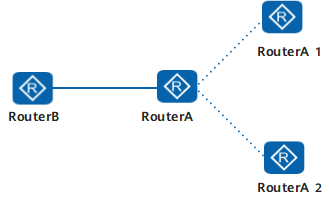
The IS-IS router can run the LSP fragment extension feature in the following modes:
Mode-1: is used when some routers on the network do not support the LSP fragment extension.
In this mode, virtual systems participate in the SPF calculation. The originating system advertises LSPs that contain information about the links to each virtual system. Similarly, each virtual system advertises LSPs that contain information about the links to the originating system. This allows the virtual systems to appear to be like the actual routers connected to the originating system on the network.
Mode-1 is a transitional mode for earlier IS-IS versions that do not support fragment extension. In the earlier versions, IS-IS cannot identify the Alias ID TLV. The LSP sent by a virtual system appears to be like a common IS-IS LSP.
The LSP sent by a virtual system contains the same area address and overload bit as that in the common LSP. If the LSPs sent by a virtual system contain TLVs specified in other features, they must be the same as those in common LSPs.
The virtual system carries neighbor information that specifies that the neighbor is the originating system, with the metric being the maximum value minus 1. The originating system carries neighbor information that specifies that the neighbor is the virtual system, with the metric of 0. This ensures that the virtual system is the downstream node of the originating system when other routers calculate routes.
As shown in Figure 1, RouterB does not support the LSP fragment extension; RouterA is set to support the LSP fragment extension in mode-1; RouterA1 and RouterA2 are virtual systems of RouterA. In this example, RouterA1 and RouterA2 send LSPs carrying routing information of RouterA. After receiving LSPs from RouterA, RouterA1, and RouterA2, RouterB detects that there are three individual routers at the peer end and calculates routes normally. Because the cost of the route from RouterA to RouterA1 and the cost of the route from RouterA to RouterA2 are both 0, the cost of the route from RouterB to RouterA is equal to the cost of the route from RouterB to RouterA1.
Mode-2: is used when all routers on the network support LSP fragment extension.
In this mode, virtual systems do not participate in the SPF calculation. All routers on the network detect that the LSPs generated by the virtual systems actually belong to the originating system.
Working in mode-2, IS-IS identifies IS Alias ID TLV, which is used to calculate the SPT and routes.
As shown in Figure 1, RouterB supports the LSP fragment extension; RouterA is set to support the LSP fragment extension in mode-2; andRouterA1 and RouterA2 send LSPs carrying routing information of RouterA. When receiving LSPs from RouterA1 and RouterA2, RouterB obtains IS Alias ID TLV and detects that the originating system of RouterA1 and RouterA2 is RouterA. RouterB detects that information advertised by RouterA1 and RouterA2 belongs to RouterA.
Whether LSP fragment extension is set to mode-1 or mode-2, LSPs in both modes can be resolved. If LSP fragment extension is not supported, only LSPs in mode-1 can be resolved.
LSP Content\Mode |
Mode-1 |
Mode-2 |
|---|---|---|
IS Alias ID |
Yes |
Yes |
area |
Yes |
No |
overload bit |
Yes |
Yes |
IS NBR/IS EXTENDED NBR |
Yes |
No |
Routing |
Yes |
Yes |
ATT bits |
must be 0 |
must be 0 |
P bit |
must be 0 |
must be 0 |
Process
After LSP fragment extension is configured, if information is lost because LSPs are of full lengths, the system prompts that the IS-IS router should be restarted. After the router is restarted, the originating system loads as much routing information as possible. The remaining information is added to the LSPs of the virtual systems for transmission.
Application Environment

Configure the LSP fragment extension and virtual systems before you set up IS-IS neighbors or import routes. Then you must restart the IS-IS router for the configurations to take effect. If you set up IS-IS neighbors or import routes first, it can cause IS-IS to carry more information than cannot be loaded through 256 fragments