IS-IS Control Messages
Intermediate System to Intermediate System (IS-IS) routers implement routing by exchanging control messages. This section describes IS-IS control messages.
IS-IS PDU Formats
Nine types of IS-IS protocol data units (PDUs) are available for processing control information. Each PDU is identified by a 5-digit type code. IS-IS has three major types of PDUs: Hello PDUs, link state PDUs (LSPs), and Sequence Number PDUs (SNPs). Table 1 shows the mapping between PDUs and type values.
PDU Type |
Acronym |
Type Value |
|---|---|---|
Level-1 LAN IS-IS Hello PDU |
L1 LAN IIH |
15 |
Level-2 LAN IS-IS Hello PDU |
L2 LAN IIH |
16 |
Point-to-Point IS-IS Hello PDU |
P2P IIH |
17 |
Level-1 Link State PDU |
L1 LSP |
18 |
Level-2 Link State PDU |
L2 LSP |
20 |
Level-1 Complete Sequence Numbers PDU |
L1 CSNP |
24 |
Level-2 Complete Sequence Numbers PDU |
L2 CSNP |
25 |
Level-1 Partial Sequence Numbers PDU |
L1 PSNP |
26 |
Level-2 Partial Sequence Numbers PDU |
L2 PSNP |
27 |
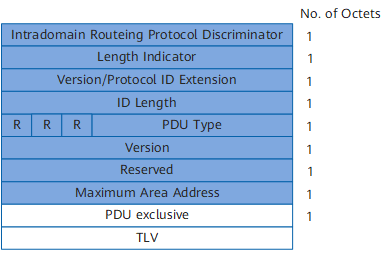
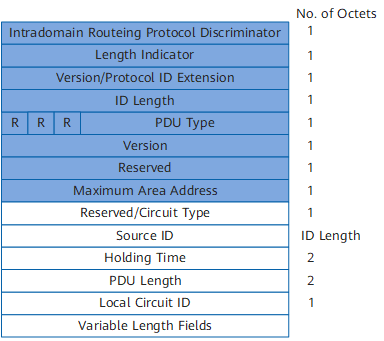
- Intradomain Routing Protocol Discriminator: network layer protocol identifier assigned to IS-IS, which is always 0x83.
- Length Indicator: length of the fixed header in bytes.
- ID Length: length of the system ID of network service access point (NSAP) addresses or NETs in this routing domain.
- PDU Type: type of a PDU. For details, see Table 1.
- Maximum Area Address: maximum number of area addresses permitted for this IS-IS area. The value 0 indicates that a maximum of three area addresses are supported in this IS-IS area.
- Type/Length/Value (TLV): encoding type that features high efficiency
and expansibility. Each type of PDU contains a different TLV. Table 2 shows the mapping between TLV codes and PDU
types.
Table 2 Mapping between TLV codes and PDU types TLV Code
TLV Code Name
PDU Type
1
Area Addresses
IIH, LSP
2
IS Neighbors (LSP)
LSP
4
Partition Designated Level2 IS
L2 LSP
6
IS Neighbors (MAC Address)
LAN IIH
7
IS Neighbors (SNPA Address)
LAN IIH
8
Padding
IIH
9
LSP Entries
SNP
10
Authentication Information
IIH, LSP, or SNP
128
IP Internal Reachability Information
LSP
129
Protocols Supported
IIH or LSP
130
IP External Reachability Information
L2 LSP
131
Inter-Domain Routing Protocol Information
L2 LSP
132
IP Interface Address
IIH or LSP
Hello Packet Format
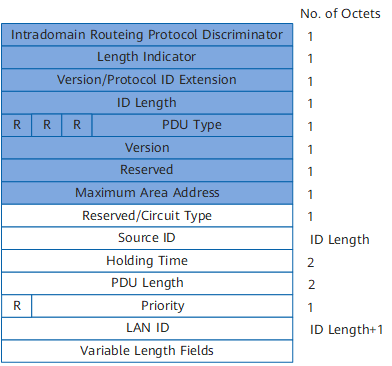
- LAN IIHs: Figure 2 shows the format of IIHs on a broadcast network.
- P2P IIHs: Figure 3 shows the format of IIHs
on a P2P network.
As shown in Figure 3, most fields in a P2P IIH are the same as those in a LAN IIH. The P2P IIH does not have the priority and LAN ID fields, but has a local circuit ID field. The local circuit ID indicates the local link ID.
LSP Format
LSPs are used to exchange link-state information. There are two types of LSPs: Level-1 and Level-2. Level-1 IS-IS transmits Level-1 LSPs. Level-2 IS-IS transmits Level-2 LSPs. Level-1-2 IS-IS can transmit both Level-1 and Level-2 LSPs.
Level-1 and Level-2 LSPs have the same format, as shown in Figure 4.
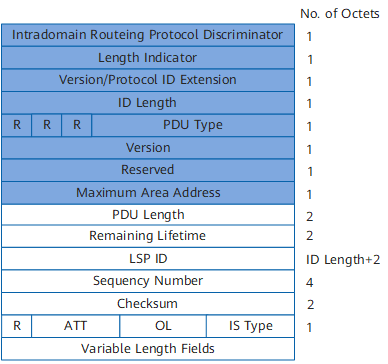
The main fields are as follows:
ATT: Attached bit
It is generated by a Level-1-2 router to identify whether the originating router is connected to other areas. When a Level-1 router receives a Level-1 LSP with ATT as 1 from a Level-1-2 router, the Level-1 router generates a default route destined for the Level-1-2 router so that data can be transmitted to other areas.
Although ATT is defined in both the Level-1 LSP and Level-2 LSP, it is set only in the Level-1 LSP only by the Level-1-2 router.
OL: LSDB overload
LSPs with the overload bit are still flooded on the network, but the LSPs are not used when routes that pass through a router configured with the overload bit are calculated. After a router is configured with the overload bit, other routers ignore the router when performing shortest path first (SPF) calculation. Only the direct routes of the router are considered.
IS Type: type of the IS-IS generating the LSP
This field is used to specify whether the IS-IS type is Level-1 IS-IS or Level-2 IS-IS. The value 01 indicates Level-1; the value 11 indicates Level-2.
SNP Format
CSNPs carry summaries of all LSPs in LSDBs, which ensures LSDB synchronization between neighboring routers. On a broadcast network, the designated intermediate system (DIS) sends CSNPs at regular intervals. The default interval is 10 seconds. On a P2P link, neighboring devices send CSNPs only when a neighbor relationship is established for the first time.
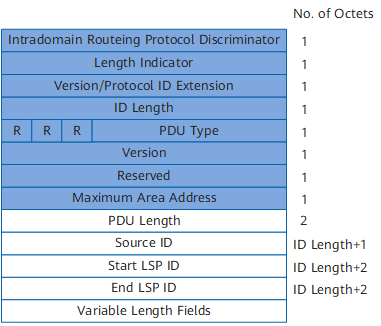
Figure 5 shows the CSNP format.
The main fields are as follows:
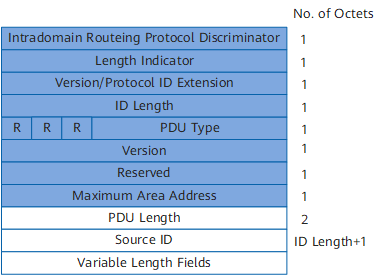
Source ID: system ID of the router that sends SNPs
Start LSP ID: ID of the first LSP in a CSNP
End LSP ID: ID of the last LSP in a CSNP
PSNPs list only the sequence numbers of recently received LSPs. A PSNP can acknowledge multiple LSPs at a time. If an LSDB is not updated, PSNPs are also used to request a neighbor to send a new LSP.
Figure 6 shows the PSNP format.