Triggered Update
Triggered update occurs when the local routing information changes and the local router immediately notifies its neighbors of the changes in routing information by sending the triggered update packet.
Triggered update shortens the network convergence time. When the local routing information changes, the local router immediately notifies its neighbors of the changes in routing information rather than wait for a periodic update.
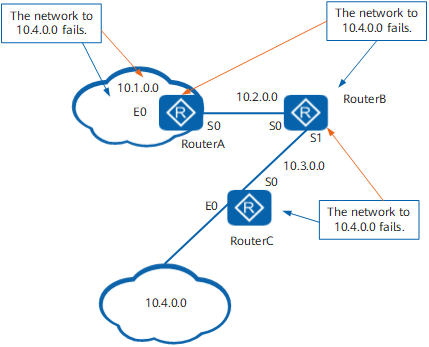
In the example in Figure 1, when network 10.4.0.0 is unreachable, RouterC learns the information first. Usually, the route update message is sent to neighbors every 30s. If the update message of RouterB is sent to RouterC when RouterC is waiting for the route update message, RouterC learns the faulty route to network 10.4.0.0 from RouterB. In this case, the routes from RouterB or RouterC to network 10.4.0.0 point to RouterC or RouterB respectively, which forms a route loop. If RouterC detects a network fault and immediately sends a route update message to RouterB before the new update interval reaches RouterB. The routing table of RouterB is updated in time, and routing loops are avoided.
Another scenario that triggers updates is when the next hop of the route is unavailable because the link is faulty. The local device needs to notify neighboring device about the routes' unreachability. The local device sets the cost the route to 16 and advertising the route. This is also called route-withdrawal.