Poison Reverse
Poison reverse allows a RIP-enabled interface to set the metric of the route that it learns from a neighbor to 16 (indicating that the route is unreachable) and then send the route back. After receiving this route, the neighbor deletes the useless route from its routing table, which prevents loops.
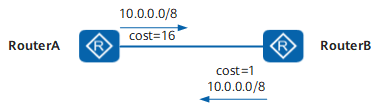
On the network shown in Figure 1, if poison reverse is not configured, Router B sends Router A a route that was learned from Router A. The metric of the route from Router A to network 10.0.0.0 is 1. If the route from Router A to network 10.0.0.0 is unreachable and Router B keeps sending Router A routes to network 10.0.0.0 because Router B fails to receive a route update packet from Router, a routing loop occurs.
If poison reverse configured, if Router A sends Router B a message that the route received from Router B is unreachable, Router B does not learn the unreachable route from Router A, which avoids route loops.
If both split horizon and poison reverse are configured, only poison reverse takes effect.