BFD for RIP
Definition
Bidirectional Forwarding Detection (BFD), as a detection mechanism, detects faults on links between neighboring routers. Associated with a routing protocol, BFD can rapidly detect link faults, report the faults to the protocol, and speed up the protocol's response to network topology changes.
BFD for RIP can rapidly detect link faults, report the faults to RIP, and speed up the RIP's response to network topology changes.
Static BFD
In static BFD, BFD session parameters (such as local and remote discriminators) are set using commands, and the BFD function must be enabled manually.
If the remote device does not support BFD, enable one-arm BFD on the local device to implement fault detection.
Dynamic BFD
Dynamic BFD refers to the dynamic establishment of BFD sessions based on routing protocols. In dynamic BFD, the local discriminator is dynamically allocated, whereas the remote discriminator is obtained from BFD packets sent by the neighbor.
When a new neighbor relationship is set up, a BFD session will be established based on the neighbor and the detection parameters including source and destination IP addresses. When a fault occurs on the link, the routing protocol associated with BFD can detect that the BFD session goes Down. Traffic is then rapidly switched to the secondary link to avoid data loss.
Dynamic BFD is more flexible than static BFD.
Purpose
A link fault on a network causes router to recalculate routes. Therefore, the convergence based on routing protocols must be as quick as possible to improve network performance. BFD can rapidly detect faults and report the faults to routing protocols.
After BFD is associated with RIP, BFD will detect the fault and report the fault to the RIP protocol in milliseconds if a fault occurs on the link. The router then deletes the failed neighbors from the routing table and switches traffic to the secondary path, speeding up route convergence.
Table 1 shows the differences of fault detection and convergence speed before and after BFD for RIP is configured:
| Configuring BFD Detection | Link Fault Detection Mechanism | Route Convergence Speed |
|---|---|---|
| N | A RIP age timer expires. By default, the timeout period of the timer is 180s. | At the second level(>180s) |
| Y | A BFD session goes Down. | At the second level(<30s) |
Principle
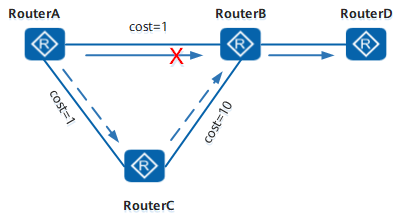
- Principles of dynamic BFD for RIP:
- RIP neighbor relationships have been established among Router A, Router B, and Router C, and between Router B and Router D.
- RIP BFD is enabled on Router A and Router B.
- After routing calculation, the next hop of the route destined for Router D from Router A is Router B.
- If a fault occurs on the link between Router A and Router B, BFD will rapidly detect the fault and report the fault to Router A. Routes whose next hop is Router B will be deleted from the routing table of Router A.
- Router A recalculates routes and chooses a new path Router C → Router B → Router D.
- After the link between Router A and Router B recovers, a new BFD session between the two routers will be established. Router A will choose a new primary link to forward packets after the BFD session is established.
- Principles of static BFD for RIP:
- RIP neighbor relationships have been established between Router A and Router B, between Router A and Router C, between Router B and Router C, Router A, Router B, and Router C and between Router B and Router D.
- Static BFD is enabled on the interface that connects Router A to Router B.
- When a fault occurs on the link between Router A and Router B, BFD will rapidly detect the fault and report the fault to Router A. Routes learned from Router B will be deleted from the routing table of Router A.
- After the link between Router A and Router B recovers, a new BFD session will be established between the two routers. Router A will choose a new primary link to forward packets after the BFD session is established.