Understanding RIPng
This section describes the RIPng mechanism.
Timer
RIPng uses the following three timers:
Update timer: The timer triggers the sending of update packets every 30 seconds. This timer synchronizes RIPng routes on the network.
Age timer: If a RIPng router does not receive any update packet from its neighbors in the aging time, the RIPng router considers the route to its neighbors unreachable.
Garbage-Collect timer: If the route is no longer valid after the timer times out, the entry is removed from the RIPng routing table.
The following describes the relationship among the three timers:
The advertisement of RIPng routing update is triggered by the update timer every 30 seconds. Each entry is associated with two timers, the age timer and the garbage-collect timer. When a route is learned and installed in the routing table, the age timer is initialized. If no Update packet is received from the neighbor for 180 seconds, the metric of the route is set to 16. At the same time, the garbage-collect timer is initialized. If no Update packet is received for 120 seconds, the entry is deleted after the garbage-collect timer times out.
Split Horizon
The principle of split horizon is that a route learnt by RIPng on an interface is not sent to neighbors from the interface. This reduces bandwidth consumption and avoids route loops.
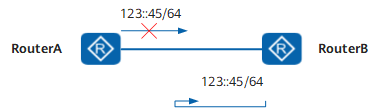
As shown in Figure 1, RouterB sends a route to network 123::45 to RouterA and RouterA does not send the route back to RouterB.
Poison Reverse
The principle of poison reverse is that RIPng sets the cost of the route learnt from an interface of a neighbor to 16 (specifying the route as unreachable) and then sends the route from the interface to the neighbor. In this way, RIPng can delete useless routes from the routing table of the neighbor.
Poison reverse of RIPng can also avoid route loops.
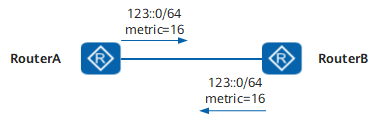
As shown in Figure 2, if poison reverse is not configured, RouterB sends RouterA a route that is learnt from RouterA. The cost of the route from RouterA to network 123::0/64 is 1. When the route from RouterA to network 123::0/64 becomes unreachable and RouterB does not receive the update packet from RouterA and thus keeps sending RouterA the route from RouterA to network 123::0/64, a route loop occurs.
If RouterA sends RouterB a message that the route is unreachable after receiving a route from RouterB, Router_B no longer learns the reachable route from RouterA, thus avoiding route loops.
If both poison reverse and split horizon are configured, simple split horizon (the route learnt from an interface is not sent back through the interface) is replaced by poison reverse.
Triggered Update
Triggered update occurs when local routing information changes and then the local router immediately notifies its neighbors of the changes of routing information by sending the triggered update packet.
Triggered update shortens the network convergence time. When local routing information changes, the local router immediately notifies its neighbors of the changes of routing information rather than waiting for periodical update.
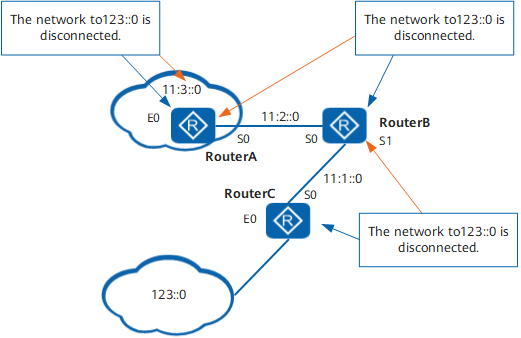
As shown in Figure 3, when network 123::0 is unreachable, RouterC learns the information first. Usually, the route update message is periodically sent to neighbors. For example, RIPng sends the route update message every 30s. If the update message of RouterB is sent to RouterC when RouterC is waiting for the route update message, RouterC learns the faulty route to network 123::0 from RouterB. In this case, the routes from RouterB or RouterC to network 123::0 point to RouterC or RouterB respectively, thus forming a route loop. If RouterC detects a network fault and immediately sends a route update message to Router B before the new update interval reaches. Consequently, the routing table of Router B is updated in time, and routing loops are avoided.
There is another mode of triggering updates: The next hop of the route is unavailable because the link is faulty. The local router needs to notify neighboring router about the unreachability of this route. This is done by setting the cost of the route as 16 and advertising the route. This is also called route-withdrawal.
Route Aggregation
RIPng route aggregation is implemented by aggregating all routes advertised on an interface according to the longest match rule.
RIPng route aggregation can improve extensibility and efficiency and minimize the routing table of a large-scale network.
Implementation of route aggregation:
For example, RIPng advertises two routes, 11:11:11::24 Metric = 2 and 11:11:12::34 Metric = 3, from an interface, and the aggregation route configured on the interface is 11::0/16. In this manner, the finally advertised route is 11::0/16 Metric = 2.
Multi-process and Multi-instance
For easy management and effective control, RIPng supports the features multi-process and multi-instance. The multi-process feature allows a set of interfaces to be associated with a specific RIPng process. This ensures that the process performs all the protocol operations only on this set of interfaces. Therefore, multiple RIPng processes can work on a single router and each process is responsible for a unique set of interfaces. In addition, the routing data is independent between RIPng processes. However, routes can be imported between processes.
For routers that support VPN, you can associate each RIPng process with a specific VPN instance. In this case, all the interfaces attached to the RIPng process should be associated with the RIPng-process-related VPN instance.