Overview of SCTP
This section defines the Stream Control Transmission Protocol (SCTP) and describes its key features.
SCTP
SCTP is a connection-oriented transfer protocol designed to transfer Packet Switched Telephone Network (PSTN) signaling over IP networks. Compared with the TCP, SCTP is a relatively new transfer protocol defined by the Internet Engineering Task Force in the year 2000.
Key Feature
The key features include cookie-based initialization protection and multi-homing.
Multi-homing
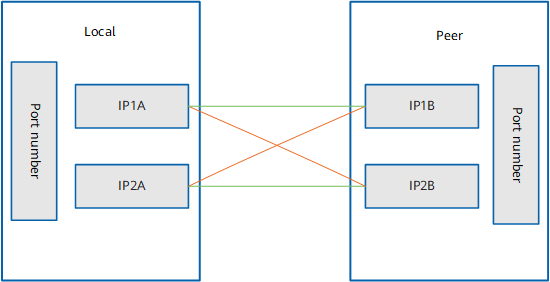
The multi-homing feature ensures that the services provided by applications using SCTP are more reliable than those provided by applications using TCP. A multi-homing host offers multiple network interfaces allocated with separate IP addresses for other hosts to access. In SCTP, the term association is used.
An association is the logical endpoint that sends or receives user datagrams and logically represents the interworking between multiple network interfaces provided by two hosts in an association established after a four-way handshake.
As shown in Figure 1, each of the local and peer hosts offers two network interfaces, and four paths are available for data transfer. In SCTP, the four paths can be bundled into an SCTP association. SCTP offers a built-in heartbeat detection mechanism to detect the availability of each path in an association. If a path fails, another path is used in data transfer.
Cookie-based initialization protection
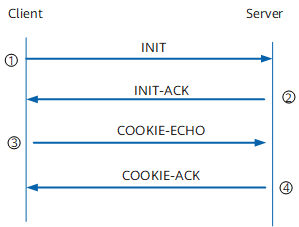
Figure 2 shows the process of a four-way handshake for the establishment of an SCTP association.
- The client sends an INIT packet.
- The server returns an INIT-ACK packet that carries a cookie.
- The client includes the received cookie into a COOKIE-ECHO packet and sends the COOKIE-ECHO packet to the server.
- The server allocates resources to the client and returns a COOKIE-ACK packet.
SCTP is a connection-oriented transfer protocol. In common cases, data can be transferred between two endpoints only after an association is established in between. That is, an SCTP association is the prerequisite for other services. SCTP associations are initiated by users, and cookies are involved in the association establishment. Cookies are data blocks that contain the initial and encrypted information. To establish an SCTP association, two endpoints have to exchange such cookies to improve data transfer security and defend against denial-of-service (DoS) and other possible attacks.