Configuring Session Aging Using the Web UI
This section describes how to use the web UI to configure session aging.
Context
You can set the session aging time for each service as required.
Generally, you can use the default session aging time. You can tune the aging time based on the traffic type and number of connections. For specific services that need to be connected for a long period of time, you are advised to configure persistent connections instead of prolonging the aging time of all traffic of a protocol type.
In certain scenarios, when the number of concurrent sessions on the FW increases rapidly, new sessions may fail to be created for normal services. In this case, you can enable the fast session aging function to accelerate the aging process. In this way, sessions can be aged in advance, rapidly reducing the session table usage.
Procedure
- Choose .
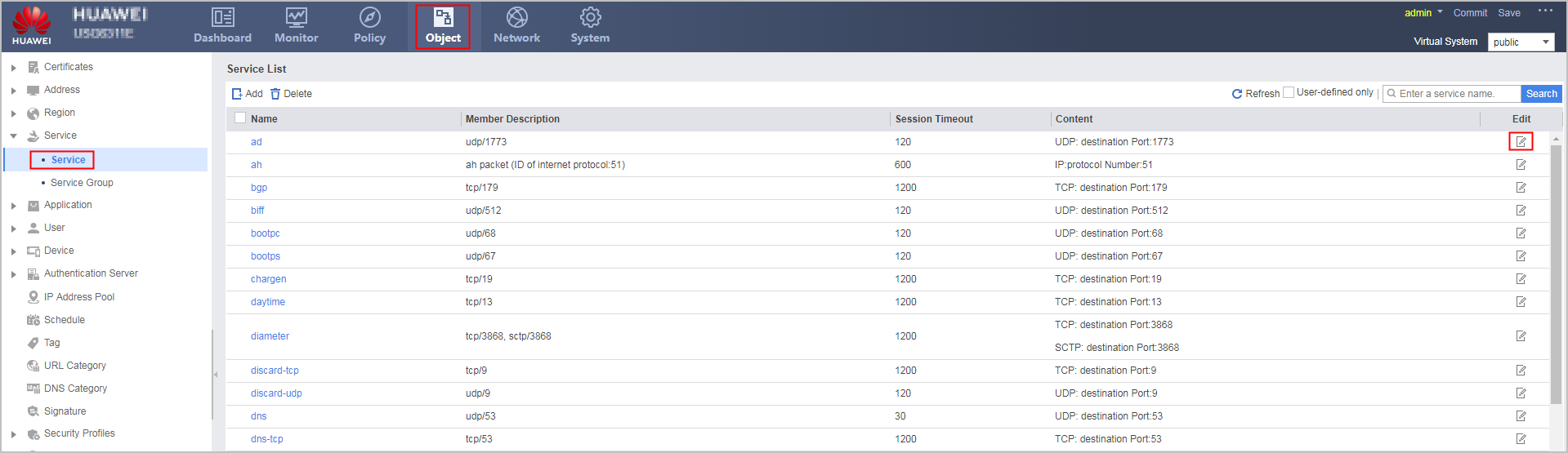
- Click
 corresponding to a service and modify Session Timeout.
You can also click Add to customize a service and set the session timeout period.
- Click OK.
- Optional: Configure the fast session aging function.

The fast session aging function does not take effect for persistent-connection sessions, and sessions with TCP/SCTP connections being established or disconnected.
- Choose .
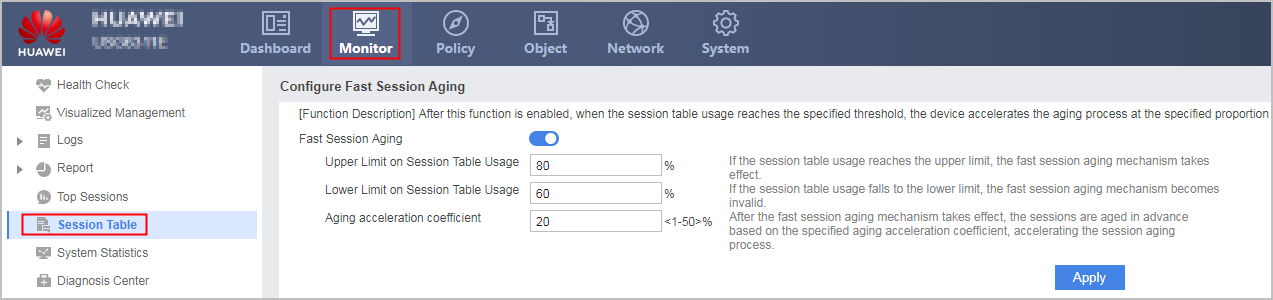
- Choose .