Overview of TWAMP Light
TWAMP Light, as a light version of the Two-Way Active Measurement Protocol (TWAMP), simplifies the control protocol used to establish test sessions and measures the round-trip performance of an IP network.
Background
TWAMP is an IP performance monitoring (IPPM) protocol and has two versions: standard version and light version. Different from standard TWAMP, TWAMP Light moves the control plane from the Responder to the Controller so that TWAMP control modules can be simply deployed on the Controller. Therefore, TWAMP Light greatly relaxes its requirements on the Responder performance, allowing the Responder to be rapidly deployed.
Characteristics
TWAMP Light integrates the Control-Client, Server, and Session-Sender on the Controller, and deploys the Session-Reflector on the Responder.
The Controller creates test sessions, collects performance statistics, and reports statistics to the NMS using Performance Management (PM) or MIBs. After that, the Controller parses NMS information and sends the results to the Responder through private channels. The Responder merely responds to TWAMP-Test packets received over test sessions.
Models
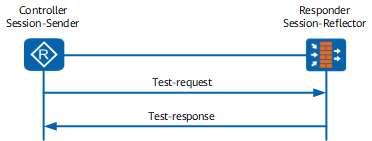
In Figure 1, TWAMP-Test packets function as probes for measuring receive and transmit performance and carry the IP address, UDP port number, and fixed TTL value 255 predefined for the test session between the Controller and Responder. The Controller sends a TWAMP-Test packet to the Responder, and the Responder replies to it. The Controller collects TWAMP statistics. The FW can act as only the TWAMP Light responder.
- Test-request packets are sent from the Controller to the Responder.
- Test-response packets are replied by the Responder to the Controller.
The Controller collects performance statistics based on TWAMP-Test packets and reports results to the NMS using PM for proactive measurement or using MIBs for on-demand measurement. The NMS provides performance statistics for users.