Overview of NetStream
The NetStream collects statistics on network traffic and periodically sends statistics to the NetStream Collector (NSC). The statistics can be used for charging, network management, and guiding the network planning.
NetStream is a statistics collection technology based on network traffic, collecting and classifying statistics on the communication traffic and resource usage over the network and providing service- and resource-specific network monitoring and management functions.
Charging
The NetStream collects refined data based on the usage of resources, such as lines, bandwidths, and time ranges. The collected data covers IP addresses, packet number, byte number, time, ToS, and applications. Based on the collected and classified data, ISPs can implement flexible charging policies based on the duration, bandwidth, application, and service quality, and enterprise customers can calculate expenses or allocate costs.
Network planning and analysis
The NetStream provides key information for the optimization of network design and planning, obtaining optimal and reliable network performance through low operating costs.
Network monitoring
The NetStream delivers real-time network monitoring. The RMON, RMON-2, and flow-based analysis technologies enable intuitive illustration of the traffic models of individual routers and the entire network, and provide advanced fault detection, effective troubleshooting, and rapid fault rectification.
Application monitoring and analysis
The NetStream also provides detailed information about network applications. For example, you can view the percentages of the traffic volume consumed by the Web, FTP, Telnet, and other well-known TCP/IP applications. Based on such information, ICPs and ISPs can effectively plan and allocate network and application resources.
Abnormal traffic detection
By analyzing NetStream flows, the NetStream detects abnormal traffic, such as attacks, over the network in real time. Based on the trap messages from the NMS and the interworking with the NMS, network security is ensured.
The NetStream mainly consists of three devices, namely, the NetStream Data Exporter (NDE), NetStream Collector (NSC), and NetStream Data Analyzer (NDA). The relationship among the three devices is shown in the following figure.
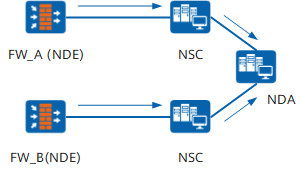
The NDE collects statistics over the passing traffic and sends detailed statistics to the NSC for filtering and merging. Then the NSC sends the filtered and merged statistics to the NDA for further merging and generation of intuitive graphs and reports. The generated graphs and reports provide a reference for network planning, network monitoring, application analysis, and fault location.
On networks, the IP network is connectionless. Therefore, the communication between different types of services is implemented through a group of IP packets sent from one terminal to another. Actually, these IP packets form the data flow of a network service. Most data flows are temporary, intermittent, and bidirectional. NetStream mainly identifies different flows and collects flow-specific statistics based on the destination and source IP addresses, destination and source ports, protocol, ToS, and input and output interfaces. Serving as an NDE, the FW periodically sends received statistics to the NSC for processing. Then the NSC sends the statistics to the NDA for data analysis and report generation.