The Device Serving as a DDNS Client to Realize Updates by the DDNS Server
This section describes the application scenario in which the device serves as a DDNS client to make the DNS server dynamically update the mapping between domain names and IP addresses by the DDNS server.
Application Environment
Take the scenario in which the Internet users access to the Web server by domain names. When the IP address of the Web server changes, to make users access to the Web server by domain name normally, you can configure the Web server as a DDNS client to send the request of updating the mapping between the domain name and the IP address. After the DDNS server receives the DDNS request from the Web server, it notifies the DNS server to dynamically update the mapping between the domain name and the IP address. In this way, although the IP address of the application server changes, the Internet users can also access to the server by the same domain name.
Typical Application
Figure 1 shows the networking in which FW serving as a DDNS Client realizes the mapping between domain names and IP addresses by the DDNS server.
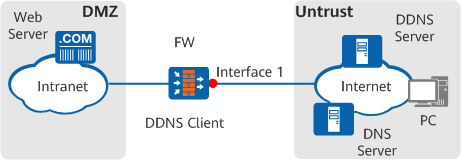
At the boarder of the enterprise network, the FW serves as a gateway. The Internet users can access to the internal Web server with the help of the NAT server by domain name. However, the public IP address of Interface 1 of the FW always changes as it obtain an IP address through dial-up. If the mapping between the domain name and the IP address of the FW, which is also the domain name of the internal Web server cannot be updated in time, the Internet users will fail to access to the Web server by domain name. At this time, you can configure the FW as a DDNS client to send the request of updating the mapping between domain names and IP addresses. Finally, the Internet users can access to the Web server of the internel enterprise network by domain name.