Interworking Between BFD and Hot Standby
This section describes the application scenario of interworking between BFD and hot standby.
Applicable Environment
The hot standby function enables the standby device to take over services from the faulty active device to ensure service continuity.
Virtual Router Redundancy Protocol (VRRP) Group Management Protocol (VGMP) groups determine the active/standby status of devices.
When BFD works with hot standby, VGMP groups are used to monitor static BFD sessions, and the priorities of VGMP groups change based on the status of BFD sessions. The change of the priorities of VGMP groups triggers active/standby switchover.
Typical Application
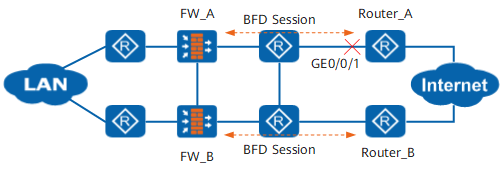
As shown in Figure 1, FW_A and FW_B are deployed on a hot standby network. FW_A functions as the active device, and FW_B functions as the standby device.
To improve network reliability and enable the FWs to monitor the status of indirectly-connected links, you need to create BFD sessions between the FW_A and the router_A and use VGMP group on the FW_A to monitor the status of BFD session. And you need to create BFD sessions between the FW_B and the router_B and use VGMP group on the FW_B to monitor the status of BFD session.
As shown in Figure 1, if interface GE0/0/1 on Router_A is faulty, the BFD session detects the interface fault (changes the status from Up to Down) and notifies the VGMP group on FW_A of the fault. Then the priority of the VGMP group on FW_A is lower than the priority of the VGMP group on FW_B and triggers active/standby switchover. Therefore, FW_A becomes the standby device, and FW_B becomes the active device.