Interworking Between BFD and Static Routes
This section describes the application scenario of interworking between BFD and static routes.
Applicable Environment
Static route is manually configured by administrators for a known path. Different from dynamic route, static route does not have the detection mechanism. When the network fails, administrator intervention is needed.
By interworking, the static route is bound to a static BFD session. Therefore, the status of the static route changes with the status of the BFD session.
Typical Application
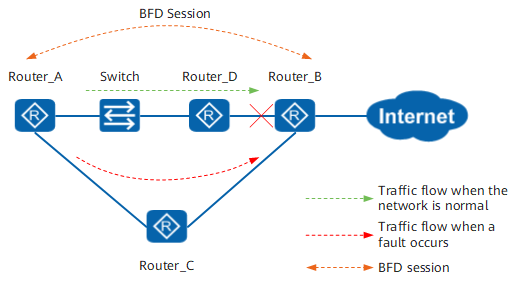
As shown in Figure 1, Router_A connects Router_B with a Layer-2 switch, and can communicate with the Internet through a static route. The link from Router_A to Router_B serves as the active link whereas the link from Router_A to Router_C to Router_B serves as the standby link.
To increase the network reliability and shorten the route convergence time, you can establish a BFD session between Router_A and Router_B to check the link status.
- If the BFD session on the static route detects a fault (the status changes from Up to Down), BFD reports the fault to the system. The system deletes this route from the routing table, and the traffic switches to the standby link.
- If the BFD session on the static route is successfully created (the status changes from Down to Up), BFD reports to the system. The system adds this route to the routing table, and the traffic switches back to the active link.
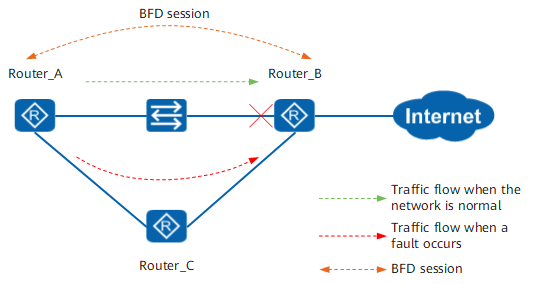
The interworking between BFD and static route supports two detection modes:
One-hop detection
Devices on both ends of the BFD session connect directly or with a Layer-2 switch, that is, the BFD session and the static route share the same outbound interface, and the IP address of the peer end is the next hop of the route. Figure 1 shows the typical application of the one-hop detection networking.
Multi-hop detection
As Figure 2 shows, the devices on both ends of the BFD session are indirectly connected with multi-hop routing channels. In this case, the BFD session binds the IP address of the peer end but not the outbound interface of the static route.