Interworking Between BFD and BGP4+
This section describes the application scenario of interworking between BFD and BGP4+.
Applicable Environment
BGP4+ enables the device to periodically send packets to the neighboring devices for fault detection, but detecting a fault takes more than 1s. When traffic is transmitted at Gbit/s rates, long-time fault detection will cause data loss, failing to meet the high reliability requirements of carrier-class networks.
Therefore, BFD interworking with BGP4+ is introduced to quickly identify link faults between BGP4+ peers (faults can be detected within milliseconds) and report the faults to BGP4+, implementing fast BGP4+ route convergence.
Typical Application
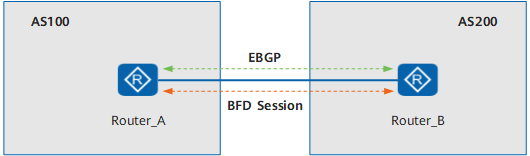
As shown in Figure 1, Router_A and Router_B respectively belong to AS100 and AS200 and establish EBGP4+ connections in between.
BFD is configured to detect the BGP4+ neighboring relationship between Router_A and Router_B. When the link between Router_A and Router_B fails, BFD can rapidly detect the fault and report it to the BGP4+ protocol.