Overview of Dual Stack
This section describes the mechanism of dual stack.
The dual-stack technology is the basis for the IPv4/IPv6 transition and other transition technologies. Nodes on a dual-stack network support both IPv4 and IPv6 protocol stacks. Source nodes select different protocol stacks based on different destination nodes. Network devices select different protocol stacks based on different protocol types of packets for processing and forwarding. The dual-stack technology can be deployed on a single network device or a dual-stack network. On a dual-stack network, all devices must support both IPv4 and IPv6 protocol stacks. Any interface connected to the dual-stack network must have both IPv4 and IPv6 addresses. Figure 1 shows the schematic diagram of dual stack.
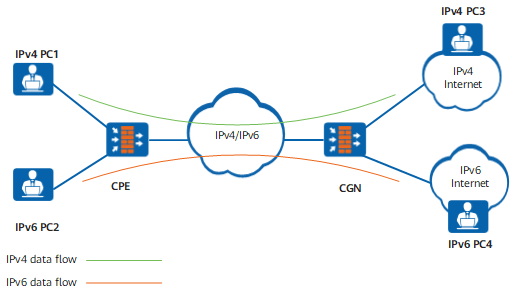
The advantages of the dual-stack technology used in the IPv4/IPv6 transition are as follows:
- On the dual-stack network, IPv6 and IPv4 service data is forwarded on different forwarding planes. Logically, two forwarding planes are considered as two networks to facilitate network deployment. The dual-stack technology supports smooth transition to the IPv6 network.
- The dual-stack network does not involve interconnection and access between IPv6 services and IPv4 services. Therefore, the implementation is simple.
- The dual-stack network is easy to maintain and manage.