Dynamic NAT64 Mapping
This section describes the dynamic NAT64 mechanism.
Dynamic NAT64 mapping applies only to scenarios where IPv6 users initiate access to the IPv4 server. The NAT64 device generates a session table for the IPv6-to-IPv4 network traffic and records the mapping. After the IPv4-to-IPv6 network traffic matches the session table, the address mapping is queried for reverse response. The detailed service procedure is shown in Figure 1.
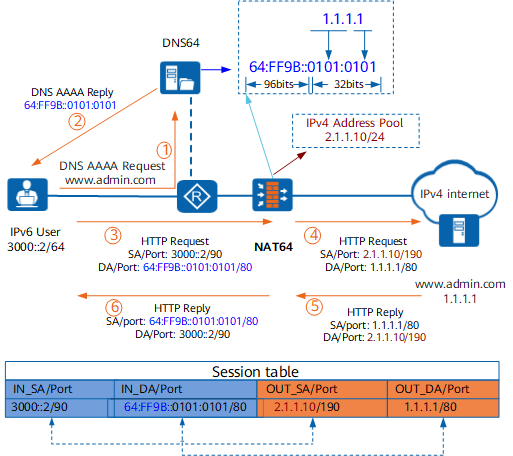
- A single-stack IPv6 user initiates an AAAA DNS request for remote services (www.admin.com).
- After receiving the request, DNS64 parses the AAAA request. If an IPv6 address cannot be found, the user sends an A request initiated again. DNS64 parses the request and finds an IPv4 address. Based on the configuration of Prefix64::/n (64:ff9b::/96), DNS64 sends the NAT64 address (64:ff9b::0101:0101) to the user. The address parsing is completed.
- After receiving the DNS64 reply, the user sends the parsed address as a destination address to the remote server.
- The NAT64 device receives the IPv6 packet from the user, and uses the address translation algorithm to extract the IPv4 address (1.1.1.1) from the IPv6 packet as the destination address for the IPv4 packet. The NAT64 device refers to the mapping configured in the NAT64 policy, uses the address in the NAT address pool as the source address (2.1.1.10) of the IPv4 packet, translates the IPv6 packet to an IPv4 packet, and sends it to the server on the IPv4 network. A session table with mapped addresses is generated.
- After receiving the packet, the server replies to the packet.
- After receiving the reply packet from the IPv4 server, the NAT64 device translates the IPv4 packet into an IPv6 packet according to the session table, and sends the IPv6 packet to the IPv6 user.