Static NAT64 Mapping
This section describes the static NAT64 mechanism.
Static NAT64 is a static permanent mapping between IPv4 and IPv6 addresses, requiring no update or aging. In this way, the IPv6-to-IPv4 and IPv4-to-IPv6 network traffic can trigger the creation of the session table, allowing IPv6/IPv4 users to access an IPv4/IPv6 server. Figure 1 shows the flowchart.
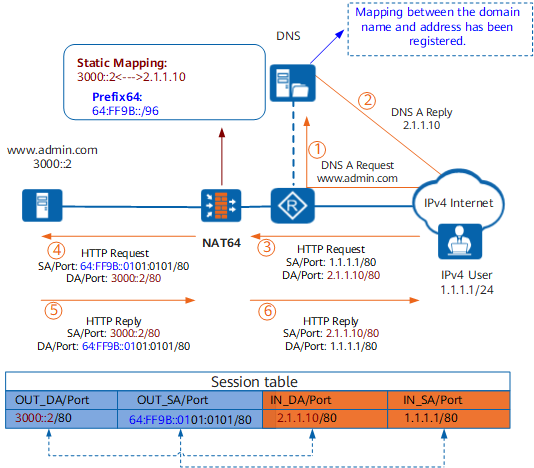
- An IPv4 user sends request A (www.admin.com) to the DNS.
- After receiving the request packet, the DNS parses the IPv4 address (2.1.1.10) corresponding to the domain name (If the request packet does not contain any IPv4 address, the packet is discarded. In this scenario, mapping between the domain name and address is predefined in the DNS), and sends the reply packet to the user.
- After receiving the DNS reply, the user sends the parsed address as a destination address to the remote server.
- After receiving the IPv4 packet from the user, the NAT64 device refers to configured static mapping (a generated server map table), translates the destination IPv4 address to an IPv6 address (3000::2) as the destination address for the IPv6 packet, combines the IPv4 packet with the configured NAT64 prefix into the source address (64:ff9b::0101:0101) for the IPv6 packet (which is translation from an IPv4 packet to an IPv6 packet), and sends it to the server on the IPv6 network. A session table is generated.
- After receiving the packet, the server replies to the packet.
- After receiving the reply packet from the IPv6 server, the NAT64 device translates the IPv6 packet into an IPv4 packet according to the session table, and sends the IPv4 packet to the IPv4 user.