Switching the System Character Encoding Format Using the Web UI
The default system character encoding format is GBK. In this format, users can enter only Chinese and English characters in the GBK encode table when configuring parameters such as policies names and user names. The characters of other languages (such as German and French) are not supported. If a language that GBK does not support is used, switch the system character encoding format to UTF-8.
Switching the encoding format requires the login to the English web UI.
Context
If no GBK-unsupported characters are used, do not switch the encoding format. Once the encoding format is switched, the Chinese web UI and CLI are unavailable.
If the UTF-8 format is required, you are strongly recommended to switch the default format to UTF-8 before configuring any services. Otherwise, some configurations may not be automatically transcoded. In addition, if the device has user authentication-related or SSL VPN configurations, the device will be restarted during transcoding, interrupting services.
Switching the System Character Encoding Format (Single-Device Networking)
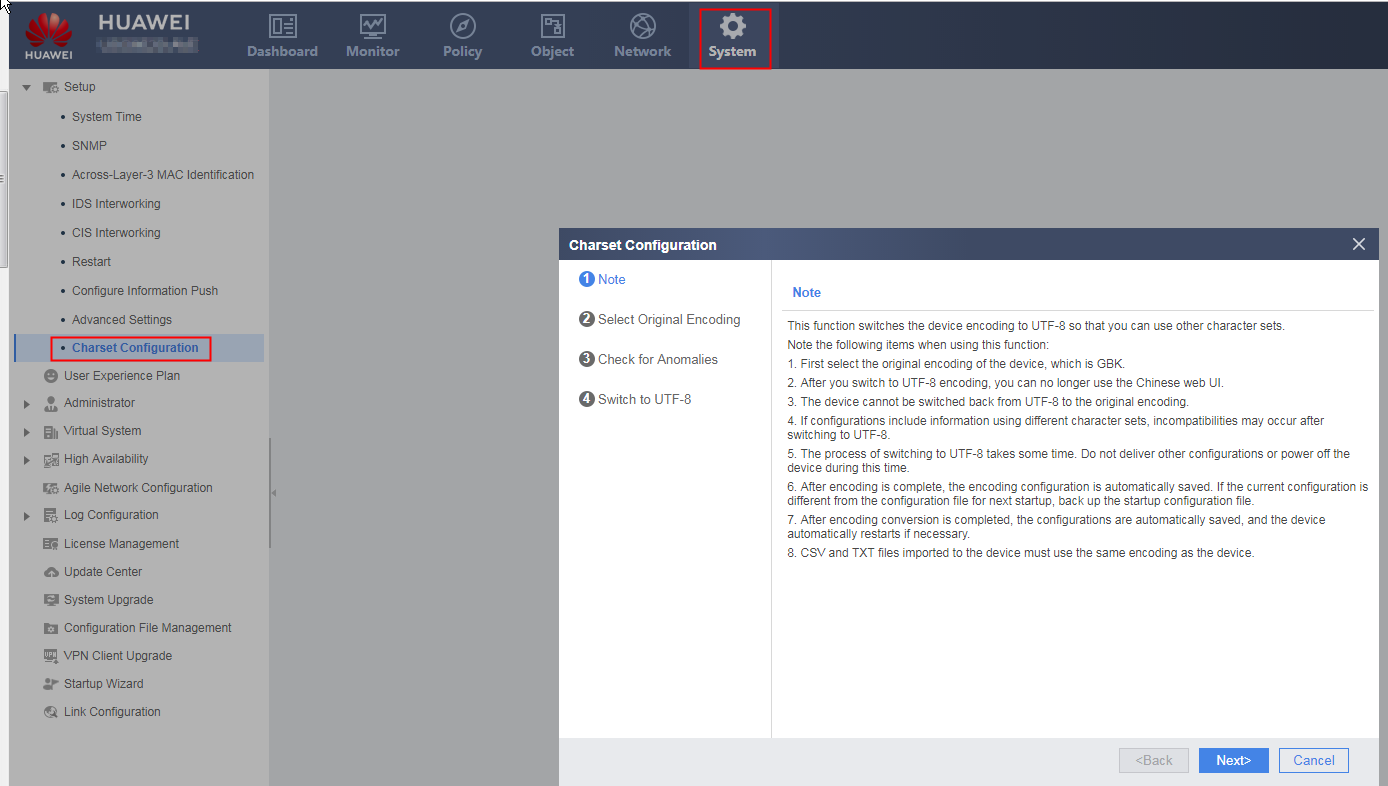
- Choose .
- Read the precautions and click Next.
- Optional: Specify the original encoding format
for existing configuration and click Next.
For a new device that does not involve transcoding for existing configurations,
directly click Next.
If the device has configurations delivered through the CLI, you must specify the original encoding format (GBK by default) before switching the encoding format to UTF-8, so that the FW can perform transcoding. When configuring the device using the CLI, administrators can set multiple encoding formats in the terminal software, and the configurations are stored on the device in the corresponding encoding formats.
If the original encoding is unknown, specify any encoding format and preview the configuration conversion result. If the result is normal without garbled characters, the specified original encoding format is correct.
Currently, the original encoding format can be GBK or UTF-8. That is, other encoding formats may not be properly transcoded to UTF-8.
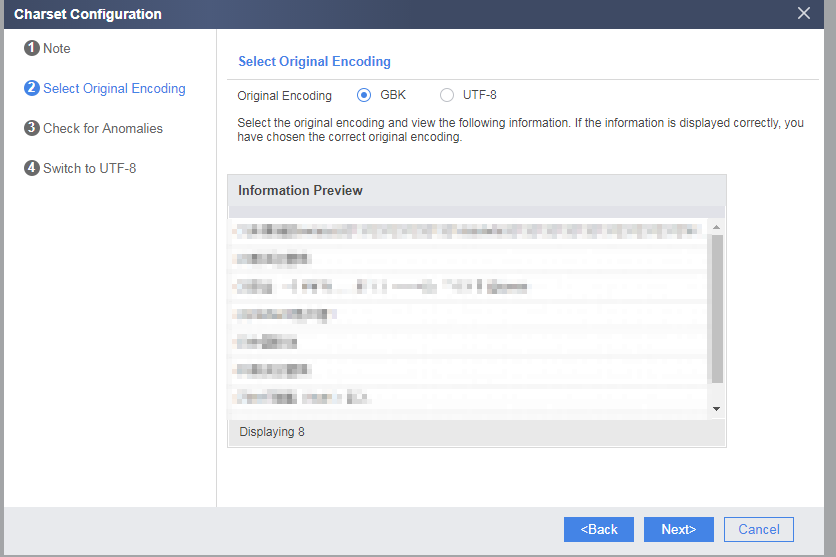

For ASCII characters such as English letters and digits, the configuration does not change after the switching between GBK and UTF-8, so the conversion effect is not displayed. The conversion effect can be displayed only when the FW has GBK characters, such as Chinese characters, for which the encoding structure needs to be changed.
As the configuration delivered through the web UI can only be in the GBK format, while the configuration delivered through the CLI can be in the UTF-8 format (depending on the CLI terminal), these two encoding formats may co-exist on the device. In this case, no matter which encoding format is specified, some garbled characters will be displayed.
- Check whether the configurations that fail to be transcoded
to UTF-8. If there are such configurations, click the hyperlink of
the corresponding module name to delete or modify them and then perform
the transcoding again. Click Next.
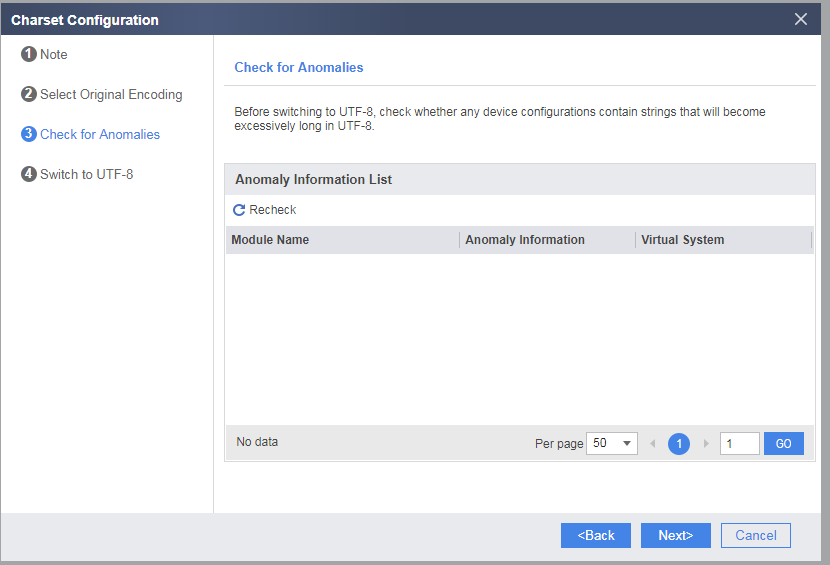
The exception configurations include overlong configurations after transcoding and configurations that cannot be transcoded. UTF-8 is a variable-length encoding format. Each character contains 1 to 6 bytes. After the encoding format is switched to UTF-8, some character strings entered in the previous GBK format may fail to be transcoded because their length exceeds that for UTF-8.
If there are many exception configurations, they may not be displayed at one time. In this case, modify the displayed exception configurations and perform the transcoding again. If the system still informs you of exception configurations, modify them. Repeat this process until all exception configurations are modified.
In the report scheduling configuration, if the name of the customized report contains non-ASCII characters (except letters, digits, and symbols) or the report language mode is Chinese, the system displays a message indicating that the encoding format cannot be switched. In this case, delete or modify the report scheduling configuration and then switch the encoding format. The name of a customized report can contain only ASCII characters.
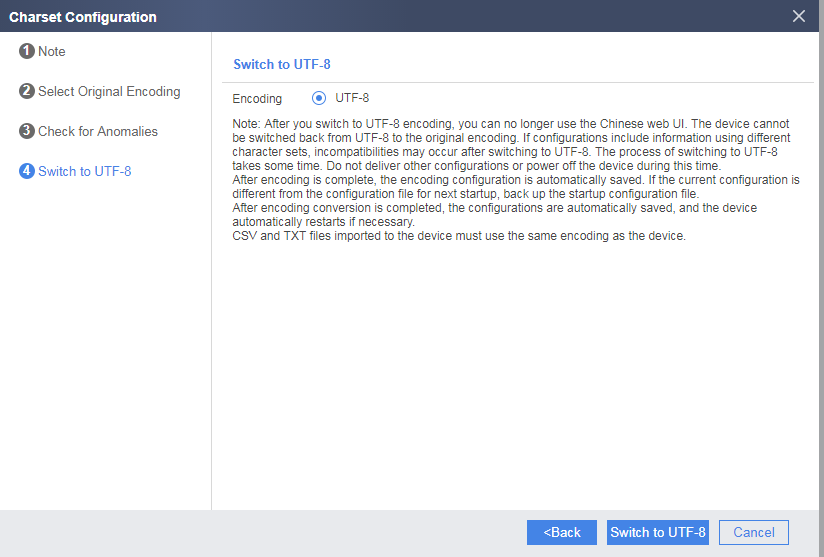
- Read the precautions and click Switch to UTF-8.
Switching the System Character Encoding Format (Active/Standby Backup Networking)
The device may be restarted during transcoding, to prevent service interruption, you should perform transcoding on the standby device first, manually switching between the active and standby devices, and perform transcoding on the original active device.
The device is restarted only when there are configurations related to user authentication. The device automatically determines whether a restart is needed. If needed, the device displays a message, indicating that transcoding can be performed only on the standby device.
During transcoding, do not deliver configurations irrelevant to transcoding on the active or standby FW. Otherwise, the configuration backed up from the active device may inconsistent with that on the standby device.
- Log in to the standby device and switch the encoding format to UTF-8 according to the procedure described in Switching the System Character Encoding Format (Single-Device Networking).
- Log in to the active device and shut down a service interface,
such as GigabitEthernet 0/0/1, to trigger an
active/standby switchover.
Choose and deselect Enable of GigabitEthernet 0/0/1.
- Switch the encoding format to UTF-8 on the currently standby device according to the procedure described in Switching the System Character Encoding Format (Single-Device Networking).
- After the currently standby device restarts, run the undo shutdown command on GigabitEthernet 0/0/1.
Choose and select Enable of GigabitEthernet 0/0/1.
Switching the System Character Encoding Format (Load Balancing Networking)
The device is restarted only when there are configurations related to user authentication. The device automatically determines whether a restart is needed. If needed, the device displays a message, indicating that transcoding can be performed only on the standby device.
During transcoding, do not deliver configurations irrelevant to transcoding on the active or standby FW. Otherwise, the configuration backed up from the active device may inconsistent with that on the standby device.
- Log in to either device and shut down a service interface,
such as GigabitEthernet 0/0/1, to trigger an
active/standby switchover.
Choose and deselect Enable of GigabitEthernet 0/0/1.
- Switch the encoding format to UTF-8 on the standby device according to the procedure described in Switching the System Character Encoding Format (Single-Device Networking).
- After the standby device restarts, run the undo shutdown command on GigabitEthernet 0/0/1.
Choose and select Enable of GigabitEthernet 0/0/1.
- Log in to the other device (active) and shut down a service
interface, such as GigabitEthernet 0/0/1, to
trigger an active/standby switchover.
Choose and deselect Enable of GigabitEthernet 0/0/1.
- Switch the encoding format to UTF-8 on the currently standby device according to the procedure described in Switching the System Character Encoding Format (Single-Device Networking).
- After the currently standby device restarts, run the undo shutdown command on GigabitEthernet 0/0/1.
Choose and select Enable of GigabitEthernet 0/0/1.