Overview of Clusters
This section describes the background and typical scenarios of the cluster function.
Currently, DC architecture is transforming from the traditional mode (three DCs in two cities) to the multi-active mode. Multi-active DCs are equal in status, not in active/standby relationships. In normal situations, the DCs collaborate and provide services at the same time, which fully utilizes resources. If one DC fails, other DCs can take over its business.
The hot standby function supported by FWs allows only two FWs in networking, not applying to the multi-active DC scenario. The FW cluster function can address this problem. Using dedicated channels for configuration and session backup among cluster members, this function enables FWs to collaborate in the multi-active DC scenario.

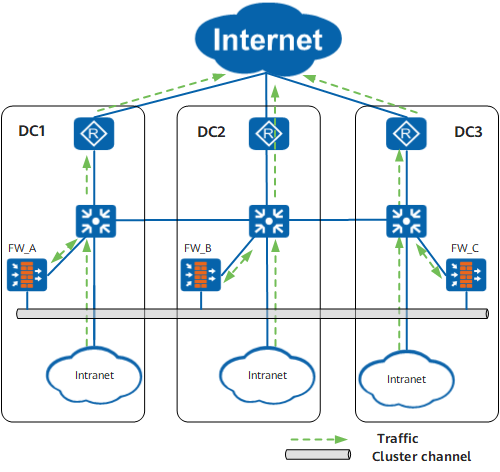
As shown in Figure 1, DC1, DC2, and DC3 are all active. In normal situations, each DC preferentially provides access services for its own business to avoid inter-DC traffic forwarding.
If FW_A in DC1 fails, FW_B in DC2 can take over its business. That is, FW_A and FW_B backs up each other, as shown in Figure 2.
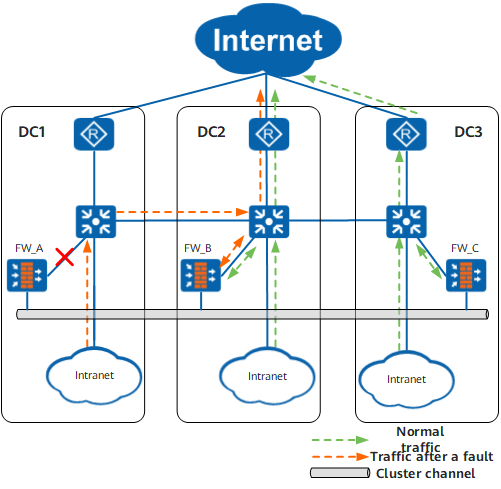
In the cluster, devices are added to a business group and ranked. If one device fails, the top backup device takes over its business, like FW_B in this example.