Implementing Hot Standby in Load Balancing Mode Using Dynamic Routing
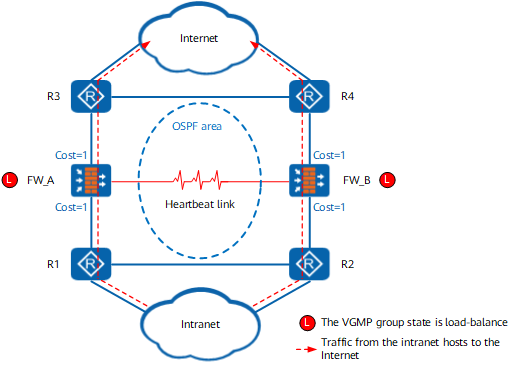
On the network shown in Figure 1, to enable the two FWs to work in load balancing mode, configure OSPF route costs on the FWs and upstream and downstream routers to evenly distribute traffic to the two FWs. For example, the default cost values of the OSPF routes on the FWs and routers in Figure 1 are set to 1. In this way, when the two FWs work normally, the cost values of the links where FW_A and FW_B are located are the same. The traffic between the intranet and Internet is processed by the FW_A and FW_B.
As shown in Figure 2, the upstream service interface of the FW_A is faulty. The state of the VGMP group changes to standby on FW_A and to active on FW_B. FW_A and FW_B adjust the OSPF costs based on the VGMP group status. The cost of the OSPF routes advertised by FW_A is changed to 65500, and the cost of the OSPF routes advertised by FW_B is changed to 1. After route convergence is complete, traffic between the intranet and Internet is diverted to FW_B for forwarding.
Similarly, if FW_B is faulty and FW_A is normal, traffic between intranet and Internet is diverted to FW_A for forwarding.
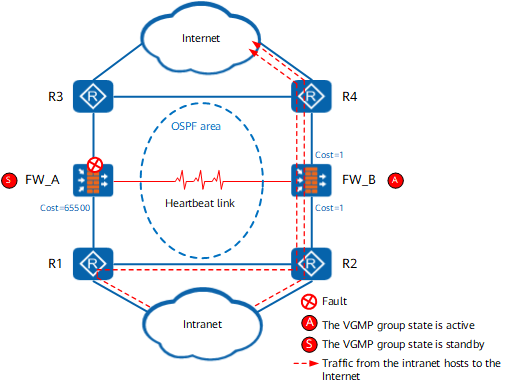
In conclusion, in normal cases, both FW_A and FW_B process traffic between the intranet and Internet. FW_A and FW_B work in load balancing mode. When either FW_A or FW_B fails, traffic is automatically switched to the normal FW to ensure service continuity.