IPv6 over IPv4 GRE Tunnel
An IPv6 over IPv4 GRE tunnel is also manually created and configured on border routers on both ends of the tunnel. However, you can configure checksum on GRE packets and verification on tunnel keywords to enhance tunnel security.
The standard GRE tunneling technology enables the IPv4 GRE tunnel to carry IPv6 packets. The tunnel regards IPv6 as a passenger protocol and GRE as a carrier protocol.
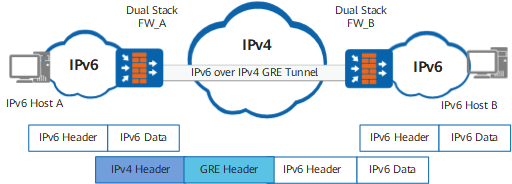
As shown in Figure 1, when host A connects to host B, the processing procedures are as follows:
- The IPv6 packet sent by host A arrives at FW_A.
- FW_A searches the IPv6 forwarding table based on the destination IP address of the IPv6 packet and discovers that the packet is forwarded by the tunnel interface.
- FW_A uses a GRE tunnel to transmit the IPv6 packet. Therefore, the original IPv6 packet is encapsulated as a GRE packet and then encapsulated into an IPv4 packet. The destination IP address in the IPv4 packet header is the source IPv4 address specified by the peer end of the tunnel, and the source IP address is the source IPv4 address specified by the local end of the tunnel. After the encapsulation, the packet is forwarded by FW_A from the tunnel interface and then routed to the destination, namely, FW_B on the IPv4 network.
- After receiving the IPv4 packet, FW_B decapsulates it, searches for a route based on the destination IP address of the IPv6 packet, and then sends the IPv6 packet to host B.
- Host B receives and responds to the packet. The response packet is processed in the same way.