IPv6 over IPv4 Automatic Tunnel
An IPv6 over IPv4 automatic tunnel uses an IPv4-compatible IPv6 address and applies only to the communication between IPv6 sites.
A tunnel requires a source and a destination. However, the IPv6 over IPv4 automatic tunnel requires the specification of only the source. The tunnel destination is automatically generated by the device. To enable the automatic generation of the destination, the IPv6 over IPv4 automatic tunnel requires an IPv4-compatible IPv6 address.
The format of such an address is shown in Figure 1. The prefix is 0:0:0:0:0:0 and the last 32 bits indicate an IPv4 address.
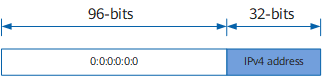
The IPv6 over IPv4 automatic tunnel is implemented by the tunnel interface. If the encapsulation mode for a tunnel interface is the IPv6 over IPv4 automatic tunnel, set the source IP address of the tunnel only, because the destination IP address is obtained from the IPv6 packet during packet forwarding. The destination address of the IPv6 packet forwarded over the IPv6 over IPv4 tunnel must be an IPv4-compatible IPv6 address, the last 32 bits of which represent the destination address of the tunnel. If the destination address of an IPv6 packet is not an IPv4-compatible IPv6 address, this packet cannot be forwarded over the IPv6 over IPv4 automatic tunnel. If the IPv4 address in the IPv4-compatible IPv6 address is a broadcast address, multicast address, all-zero address, or loopback address, the IPv6 packet is discarded. The destination node of the IPv6 over IPv4 automatic tunnel is the destination node of the encapsulated IPv6 packet. Therefore, the decapsulated packet is not forwarded.
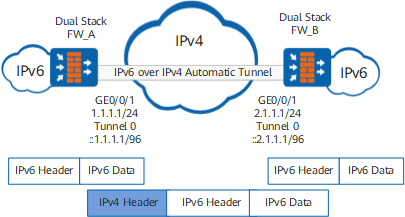
Figure 2 shows the processing procedures:
- After the IPv6 packets destined for FW_B arrive at FW_A, FW_A searches for the route and discovers that the packets are forwarded by the tunnel interface.
- The configurations on FW_A determine that an IPv6 over IPv4 automatic tunnel is to be established. Then FW_A encapsulates the original IPv6 packets into IPv4 packets. The source IP address of the IPv4 packets is the address (1.1.1.1) of the tunnel source, and the destination address is the last 32 bits of the IPv4-compatible IPv6 address (2.1.1.1).
- Encapsulated packets are forwarded by FW_A from the tunnel interface and routed to FW_B over the IPv4 network.
- After receiving the IPv4 packets, FW_B decapsulates them into IPv6 packets and sends them to the IPv6 protocol stack.