Understanding IPv4 over IPv6 Tunnel
An IPv4 over IPv6 tunnel connects IPv4 islands on an IPv6 network.
During the later phase of the transition from the IPv4 Internet to the IPv6 Internet, most networks are of IPv6, with IPv4 islands scattered. Through the IPv4 over IPv6 tunneling technology, you can create tunnels on IPv6 networks to connect IPv4 islands. There are two types of IPv4 over IPv6 tunnels: IPv4 over IPv6 manual tunnel and DS-Lite tunnel. For details on DS-Lite tunnels, see the DS-Lite section. This section focuses on IPv4 over IPv6 manual tunnels.
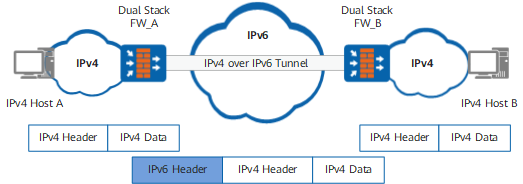
As shown in Figure 1, when host A connects to host B, the processing procedures are as follows:
- The IPv4 packet sent by host A arrives at FW_A.
- FW_A searches the IPv4 forwarding table based on the destination IP address and discovers that the packet is forwarded by the tunnel interface.
- FW_A encapsulates the IPv4 packet into an IPv6 packet. The destination IP address in the IPv6 packet header is the source IPv6 address specified on the peer end of the tunnel, and the source IP address is the source IPv6 address specified by the local end of the tunnel. After the encapsulation, the packet is forwarded by FW_A from the tunnel interface and then routed to the destination, namely, FW_B on the IPv6 network.
- FW_B receives the IPv6 packet, decapsulates it, and takes out the IPv4 packet. Because FW_B is a dual-stack device, it searches for a route based on the destination IP address of the IPv4 packet and sends it to host B.
- Host B receives and responds to the IPv4 packet.