< Home

Web: Example for Outputting Customized Netflow Session Logs to a Log Host

This section provides an example for outputting customized netflow session logs to a third-party log host through the web UI.

Networking Requirements

As shown in Figure 1, the FW is deployed on the network border. The network environment is as follows:

  • The intranet is the Trust zone, while the Internet is the Untrust zone. Users on the intranet access the Internet using the NAT function provided by the FW.
  • A third-party log server is deployed in the DMZ.

The FW is required to send session information generated when intranet users access the Internet to the third-party log server in the customized netflow IPv4 format. The administrator can view and analyze session information on the third-party log server.
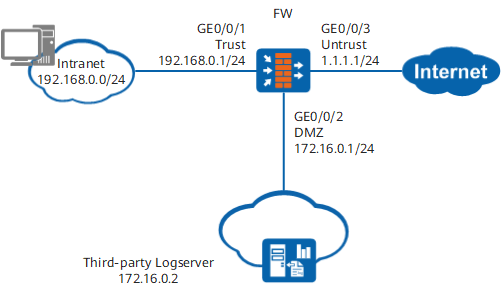
Figure 1 Networking for outputting session logs to third-party log servers

Configuration Roadmap

This example provides only the FW configuration. For the third-party log server configuration, see the third-party log server product document.

The system time must be set correctly during the initial configuration. Changing the system time during device running will result in incorrect timestamps in historical logs. The time zone of the log server must be the same as that of the FW.

  1. Set the IP addresses for interfaces and add the interfaces to security zones.
  2. Configure security policies.
  3. Configure a NAT policy.
  4. Configure routes.
  5. Configure log hosts.
  6. Enable the session log function in a security policy.
  7. Customize the netflow format.

Procedure

  1. Set the IP addresses for interfaces and add the interfaces to security zones.

    1. Choose Network > Interface.

    2. Click GE0/0/1 and set the following parameters.

      Zone

      trust

      IPv4

      IP Address

      192.168.0.1/24

    3. Click OK.

    4. Repeat the preceding steps to configure GE0/0/2.

      Zone

      dmz

      IPv4

      IP Address

      172.16.0.1/24

    5. Repeat the preceding steps to configure GE0/0/3.

      Zone

      untrust

      IPv4

      IP Address

      1.1.1.1/24

  2. Configure security policies.

    1. Choose Policy > Security Policy > Security Policy.
    2. Click Add and configure a security policy from Trust to Untrust.
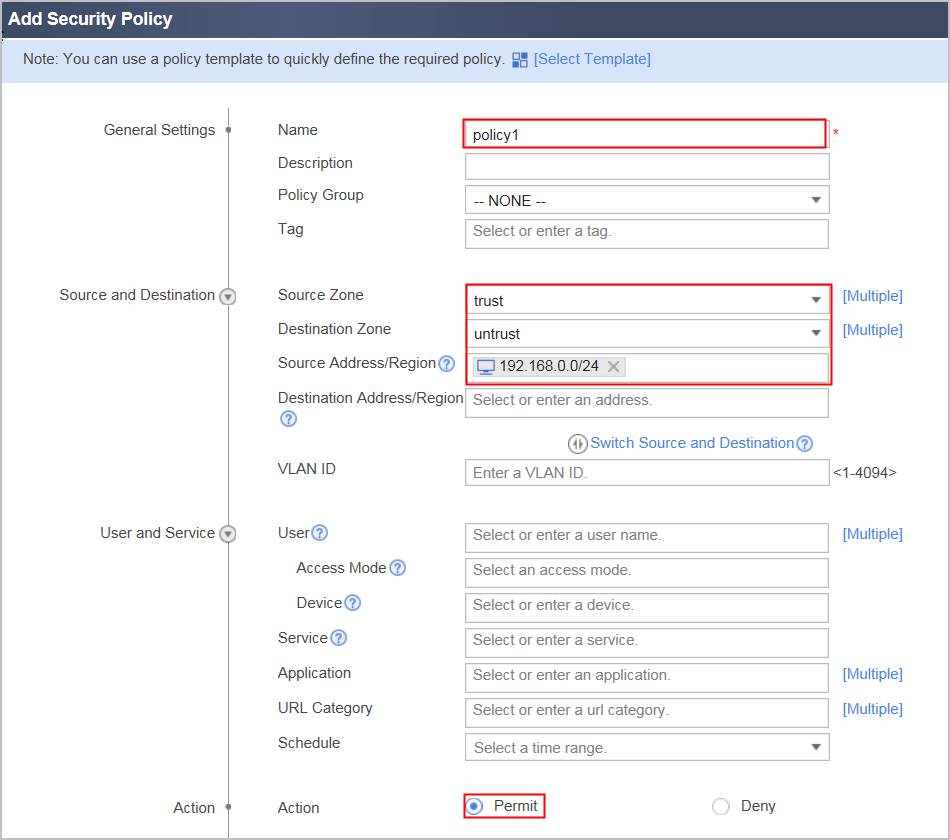
    Session log packets are not controlled by packet filtering. Therefore, you do not need to configure session log security policies. You only need to configure the preceding security policies.

  3. Configure a NAT policy.

    Configure the NAT address pool and use the PAT mode (also the default mode). If the mode no-pat command is used here to specify the No-PAT mode, the FW will generate No-PAT-mode session logs. You can check the corresponding log information in Session Analysis > IPv4 Session Query > IPv4 No-PAT on the eLog.
    1. Choose Policy > NAT Policy > NAT Policy > NAT Policy.
    2. Click the Source Translation Address Pool tab, click Add, configure the NAT address pool according to the following parameters, and click OK.

      Name

      addr1

      IP Address Range

      1.1.1.10-1.1.1.1.15

    Configure the NAT policy and reference the NAT address pool.
    1. Choose Policy > NAT Policy > NAT Policy > NAT Policy, click Add in NAT Policy List, and configure the NAT policy as follows. Click OK.

      Name

      policy1

      NAT Type

      NAT

      Source Zone

      trust

      Destination Type

      Destination Zone (untrust)

      Source Address

      192.168.0.0/24

      Translated After

      Translated Mode

      IP Address in the IP Address Pool

      Address Pool

      addr1

  4. Configure routes.

    # Configure a default route. In this example, the next hop of the FW to the Internet is 1.1.1.2.

    1. Choose Network > Route > Static Route.

    2. In Static Route List, click Add and configure a default route based on the following parameter values.

      Protocol

      IPv4

      Destination Address/Mask

      0.0.0.0/0.0.0.0

      Next Hop

      1.1.1.2

    3. Click OK.

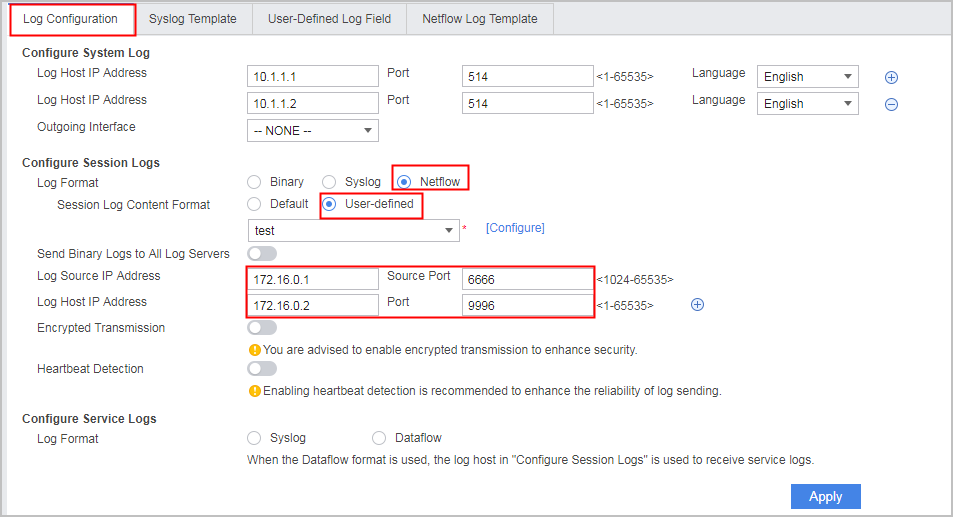
  5. Configure the log host and the source IP address and source port for sending logs.

    Choose System > Log Configuration > Log Configuration.

  6. Enable the session log function.

    # Enable the record function for session logs in the security policy for service traffic.

    Choose Policy > Security Policy > Security Policy, click the created security policy policy1, and enable the function of recording session logs in Other Options > Record Session Logs.

  7. Customize the netflow session log format.

    1. Choose System > Log Configuration > Log Configuration > Netflow Log Template.
    2. Click Add to add a netflow session log template.
    3. Enter Name and ID, and select IPv4 or IPv6.
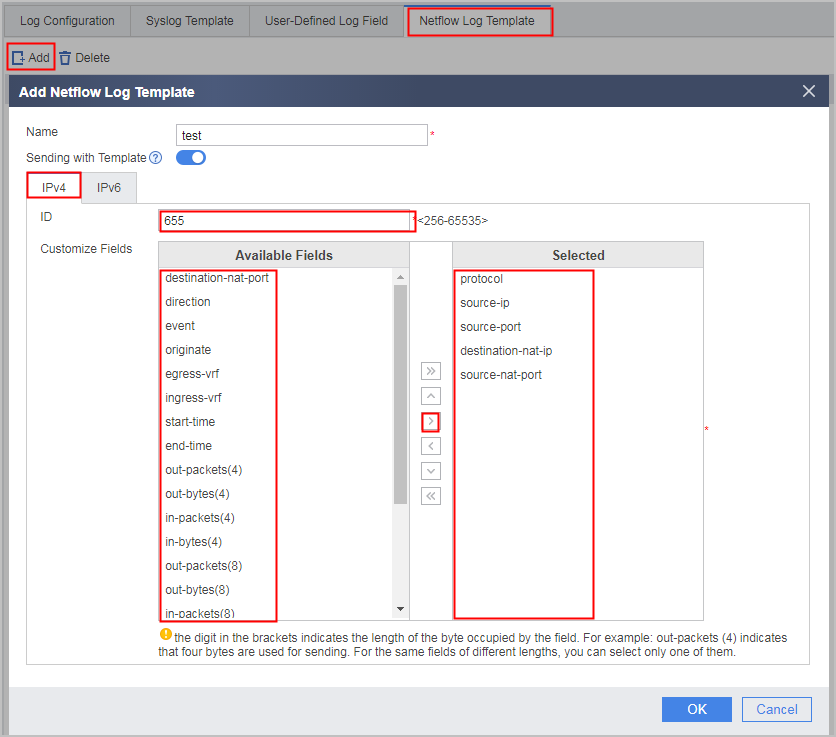
      • Sending with Template is enabled by default. In this mode, netflow session logs contain the log header, template, and flow information. If Enable is deselected, netflow session logs do not carry template data. You need to negotiate with the third-party log host to determine whether to carry template data.
      • The IPv4 and IPv6 IDs in the same template cannot be the same, and the IPv4 and IPv6 IDs in different templates can be the same.
    4. Select a log field to be appeared and click the arrow on the right of the field.

      Log fields are listed in sequence. Those selected earlier are displayed at the beginning. You can also adjust the position of a log field or delete a log field by clicking the corresponding icon.

    5. Choose System > Log Configuration > Log Configuration > Log Configuration, set the netflow session log format to User-defined, and apply the configured netflow session log template.

  8. Configure the third-party log host and view logs on the host.

Configuration Scripts

#                                                                                                                                   
 sysname FW                                                                      
#                                                                                                                                   
 firewall log host 1 172.16.0.2 9996                                                                                                
#                                                                                                                                    
nat address-group add1                                                                                                       
 mode pat                                                                                                                           
 route enable
 section 0 1.1.1.10 1.1.1.1.5                                                                                                        
#                                                                                                                                   
interface GigabitEthernet 0/0/1                                                                                                      
 undo shutdown                                                                                                                      
 ip address 192.168.0.1 255.255.255.0                                                                                               
#                                                                                                                                   
interface GigabitEthernet 0/0/2                                                                                                     
 undo shutdown                                                                                                                      
 ip address 172.16.0.1 255.255.255.0                                                                                                
#                                                                                                                                   
interface GigabitEthernet 0/0/3
                                                                                                      
 undo shutdown                                                                                                                      
 ip address 1.1.1.1 255.255.255.0                                                                                                   
#                                                                                                                                   
firewall zone trust                                                                                                                 
 set priority 85                                                                                                                    
 add interface GigabitEthernet 0/0/1                                                                                                 
#                                                                                                                                   
firewall zone untrust                                                                                                               
 set priority 5                                                                                                                     
 add interface GigabitEthernet 0/0/3
                                                                                                 
#                                                                                                                                   
firewall zone dmz                                                                                                                   
 set priority 50                                                                                                                    
 add interface GigabitEthernet 0/0/2                                                                                                 
#                                                                               
security-policy 
 rule name trust_untrust                                                        
  session logging                                                               
  source-zone trust                                                             
  destination-zone untrust                                                      
  source-address 192.168.0.0 24                                                 
  action permit                                                                 
#                                                                                                                                   
nat-policy                                                                                         
 rule name policy1                                                              
  source-zone trust                                                             
  destination-zone untrust                                                      
  source-address 192.168.0.0 24                                                 
  action source-nat address-group add1                                                                                                             
#                                                                                                                                   
 ip route-static 0.0.0.0 0.0.0.0 1.1.1.2                                                                                            
#  
session-log template name1 type netflow                                                                                                                                
template id 655 ipv4 content protocol source-ip source-port source-nat-ip source-nat-port
firewall log session log-type netflow template name1
#                                                                                                                                   
return
Copyright © Huawei Technologies Co., Ltd.
< Previous topic Next topic >