Advertising and Managing Labels
LDP peers send messages, such as Label Mapping messages, over an LDP session to exchange label information with each other to establish an LSP. RFC 5036 defines the label advertisement, distribution control, and retention modes.
Combination of the DU label advertisement mode, ordered label control mode, and liberal label retention mode
Combination of the DoD label advertisement mode, ordered label control mode, and conservative label retention mode

On the FW, LDP by default works in the DU label advertisement mode, ordered label control mode, and liberal label retention mode.
Label Advertisement Mode
An LSR on an MPLS network binds a label to a specific FEC and notifies its upstream LSRs of the binding. This process is called label advertisement.
Label advertisement modes are as follows:
Downstream unsolicited (DU)
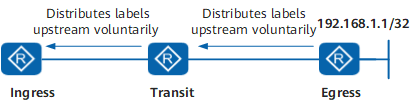
An LSR binds a label to a specified FEC and notifies its upstream LSR of the binding, without having to receive a Label Request message sent by an upstream LSR.
As shown in Figure 1, the egress sends an unsolicited Label Mapping message to the upstream transit node to advertise the label of the host route to 192.168.1.1/32.
Downstream on demand (DoD)
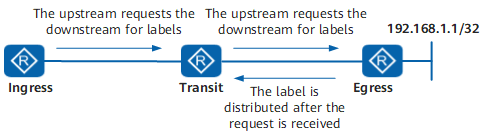
An LSR binds a label to a specified FEC and notifies its upstream LSR of the binding only after receiving a Label Request message from an upstream LSR.
As shown in Figure 2, the upstream ingress sends the Label Request message. The downstream egress receives this message and sends the Label Mapping message upstream to advertise the label of the host route to 192.168.1.1/32.
An upstream LSR and that on a downstream LSR must use the same label advertisement mode.
Label Distribution Control Mode
The label distribution control mode defines how an LSR distributes labels.
The label distribution control modes are classified into the following categories:
Independent label distribution control
A local LSR can assign a label bound to an FEC to an upstream LSR even though the local LSR does not receive a label distributed by a downstream LSR.On the network shown in Figure 1, if the label distribution mode is DU and the label distribution control mode is Independent, the transit LSR distributes labels for the ingress without waiting for labels for the egress.
On the network shown in Figure 2, if the label distribution mode is DoD and the label distribution control mode is Independent, the directly connected transit of the ingress that sends the Label Request message replies with labels without waiting for labels from the egress.
Ordered label distribution control
A local LSR sends a Label Mapping message to an upstream LSR only when the local LSR is the egress or only after it receives a Label Mapping message from a downstream LSR.
As shown in Figure 1, the label distribution mode is DU and the label distribution control mode is ordered. The transit LSR must receive a Label Mapping message from the downstream egress before it distributes a label to the ingress.
As shown in Figure 2, if the label distribution mode is DoD and the label distribution control mode is Ordered, the transit node directly connected to the ingress that sends the Label Request message must receive a Label Mapping message from the downstream egress. Then, it can distribute a label upstream to the ingress.
Label Retention Mode
The label retention mode defines how an LSR preserves a Label Mapping message.
The label mapping that an LSR receives may or may not originate at the next hop.
The label retention modes are classified into the following categories:
Liberal label retention mode
An LSR preserves Label Mapping messages sent by all LSRs, regardless of whether the LSR is its next hop.
Conservative label retention mode
An LSR preserves Label Mapping messages sent only by next-hop LSRs.
If the next hop of an LSR changes, either of the following situations occurs:
In Liberal mode, the LSR can use an existing label advertised by a non-next LSR to quickly establish an LSP. Liberal mode requires more memory and label space than conservative mode.
An LSP that is assigned a label but is not successfully established called a Liberal LSP.
In Conservative mode, the LSR only preserves the label advertised by a new next hop. In most cases, the conservative and DoD modes are used simultaneously. This mode saves memory and label space but the LSP is reestablished more slowly.
Conservative label retention mode is usually used together with DoD on the LSRs that have limited label spaces.