Basic Concepts
This section describes basic multicast concepts, including multicast group, multicast source, multicast group member, multicast router, and multicast distribution tree.
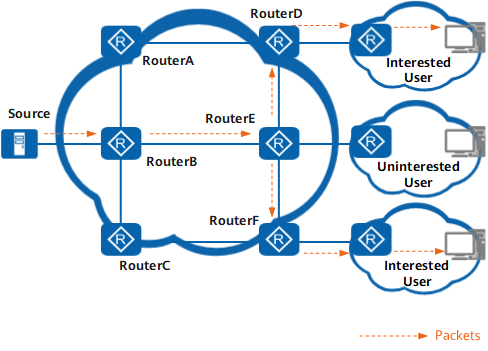
- Multicast group: an arbitrary group of receivers that want to receive a particular data stream. Hosts that want to receive the data stream for a particular group must join the group.
- Multicast source: a sender of data streams, for example, Source in Figure 1. One multicast source can send data to multiple multicast groups at the same time and multiple multicast sources can send data to one multicast group at the same time. Multicast sources do not need to join any multicast group.
- Multicast group member: a host that successfully joins a multicast group, for example, Interested User in Figure 1. Multicast group members are dynamic. Hosts can join or leave a multicast group at any time. Multicast group members can reside anywhere on networks.
- Multicast router: the router that supports multicast function on the network is called multicast router. The multicast router described in this manual indicates the FW running the multicast function. A multicast router cannot only route packets to receivers but also manage multicast group members on the leaf network connected to user hosts. A multicast router can also be a multicast group member.
- Multicast distribution tree: based on member distribution, the multicast routing protocol sets up routing in the shape of a tree for forwarding data packets to multiple destinations. Packets are copied and distributed at the farthest branch from the source and are sent to members of the multicast group.

The following example compares multicast transmission to a TV channel:
The multicast group is the link between a sender and a receiver, like a TV channel.
The TV station acts as the multicast source and sends packets to the channel.
The TV is the receiver host. Audiences turn on the TV and select the program of their choice on a channel, which is like hosts joining a group. The TV plays the channel's programs, which is like hosts receiving data sent to the group.
Audiences can turn the TV on or off or switch channels randomly, just as hosts dynamically join or leave a multicast group.