Basic Framework
The basic Framework of IP multicast includes the addressing mechanism, host registration, multicast routing, and multicast application.
Multicast models are complex and varied. The basic purpose is to transmit data from a source to receivers in multicast mode and meet their various requirements. Table 1 shows the items that should be noted in multicast.
Item |
Solution |
|---|---|
To know whether there is a receiver |
Host registration |
To locate the multicast source |
Multicast source discovery technology |
To know where the multicast information is sent |
Multicast addressing mechanism |
To forward multicast data |
Multicast routing |
IP multicast is an end-to-end service. Figure 1 shows the four parts in IP multicast from the lower protocol layer to the upper protocol layer.
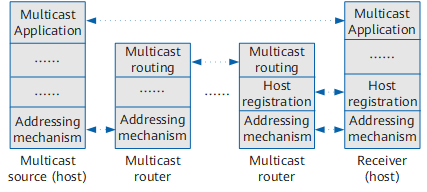
Addressing mechanism: transmits the data to a group of receivers based on the multicast address.
Host registration: allows the host to join or leave a group dynamically, which helps manage group members.
Multicast routing: sets up a distribution tree to transmit packets from the source to the receivers.
Multicast application: multicast sources and receivers must support multicast application software, such as video conferencing. The TCP/IP protocol suite must support the transmission and receipt of multicast information.