Multicast Addresses
This describes the range and meaning of IPv4 and IPv6 multicast addresses.
Multicast transmission involves the destination to which a source sends a packet and the destination address of a multicast packet. This information is referred to as multicast addressing.
Based on multicast IP addresses, multicast services are provided on the network. As a result, communication between a source and its receivers can be achieved across the Internet.
Link layer multicast is needed to transmit multicast data within the local physical network. When the Ethernet is applied to the link layer, the link layer multicast uses a MAC multicast address.
Specific technology is needed to map IP multicast addresses into MAC multicast addresses.
IPv4 Multicast Addresses
The IPv4 address is classified into five classes: A, B, C, D, and E. Class D is an IPv4 multicast address and is used to identify multicast groups in the destination address field of the IP packet.
The source IP address field of an IP multicast packet is a unicast address. A class A, B, or C address can be used. The class D address cannot be a source IP address. The class E address is reserved.
On the network layer, all receivers of a multicast group are identified by the same IPv4 multicast group address. Once a user joins the group, the IP packet sent to the group is transmitted to the user.
As shown in Table 1, Class D multicast addresses range from 224.0.0.0 to 239.255.255.255.
Class D Address Range |
Description |
|---|---|
224.0.0.0 to 224.0.0.255 |
Indicates permanent multicast group addresses reserved for routing protocols. |
224.0.1.0 to 231.255.255.255 233.0.0.0 to 238.255.255.255 |
Indicates temporary ASM group addresses available throughout the entire network. |
232.0.0.0 to 232.255.255.255 |
Indicates temporary SSM group addresses available throughout the entire network. |
239.0.0.0 to 239.255.255.255 |
Indicates temporary ASM group addresses available only in the local administration domain. The local administration multicast address is a private one, which can be used in different multicast administration domains without any conflict. |
Permanent multicast group address (also called a reserved multicast group): reserved for route protocols by IANA. It is used to identify a group of specific network devices. For details, see Table 2. The address remains unchanged. The number of members varies, and can even be 0.
Temporary multicast group address (also called a common group address): assigned for the user group temporarily. If there is no user, the address is canceled.
Permanent Multicast Group Address |
Description |
|---|---|
224.0.0.0 |
Unassigned |
224.0.0.1 |
Addresses of all hosts and routers in the network segment (it is equal to the broadcast address) |
224.0.0.2 |
Addresses of all multicast routers |
224.0.0.3 |
Unassigned |
224.0.0.4 |
Distance Vector Multicast Routing Protocol (DVMRP) devices |
224.0.0.5 |
OSPF devices |
224.0.0.6 |
OSPF DR |
224.0.0.7 |
ST devices |
224.0.0.8 |
ST hosts |
224.0.0.9 |
RIP-2 devices |
224.0.0.11 |
Mobile agents |
224.0.0.12 |
Dynamic Host Configuration Protocol (DHCP) server/Relay agents |
224.0.0.13 |
All PIM devices |
224.0.0.14 |
Resource Reservation Protocol (RSVP) encapsulation |
224.0.0.15 |
All CBT devices |
224.0.0.16 |
Specified Successful Backward Setup Information Message (SBM) |
224.0.0.17 |
All SBMSs |
224.0.0.18 |
Virtual Router Redundancy Protocol (VRRP) |
224.0.0.19 to 224.0.0.21 |
Undefined addresses |
224.0.0.22 |
All routers enabled with IGMPv3 |
224.0.0.23 to 224.0.0.255 |
Unassigned addresses |
Multicast MAC Addresses
- The last bit in the first byte of a unicast address is fixed at 0.
- The last bit in the first byte of a multicast address is fixed at 1.
The multicast-MAC address is used to identify receivers of the same multicast group at the link layer.
The Ethernet interface board on the network device can identify multicast MAC addresses. When a multicast MAC address is configured in the driver, the device can receive and forward the multicast group data on the Ethernet. The mapping between the multicast IPv4 address and multicast IPv4 MAC address is as follows:
The Internet Assigned Numbers Authority (IANA) determines that the higher-order 24 bits of the IPv4 MAC address are 0x01005e, the 25th bit is 0, and the low-order 23 bits of a IPv4 MAC address are the same as those of a multicast IPv4 address. Figure 1 shows the mapping relationship between the multicast IPv4 address and multicast IPv4 MAC address.
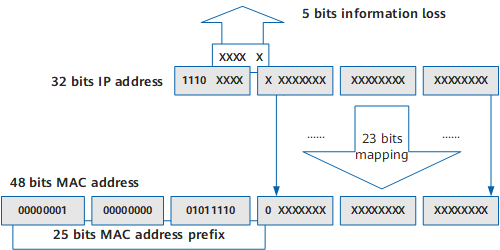
The first four bits of the IPv4 multicast address, 1110, corresponds to the high-order 25 bits of the multicast IPv4 MAC address. In the last 28 bits, only 23 bits are mapped into the MAC address, resulting in the loss of five bits of the address information. Only 32 IPv4 multicast addresses, therefore, are mapped into the same MAC addresses.
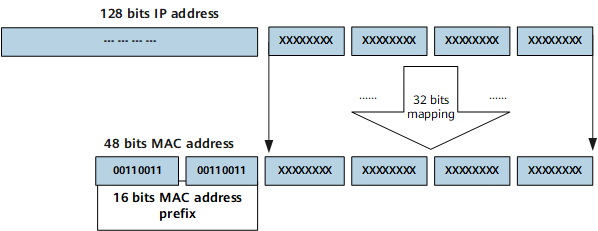
As defined by the IANA, the higher-order 16 bits of an IPv6 multicast MAC address are 0x3333, and the low-order 32 bits an IPv6 multicast MAC address are the same as those of a multicast IPv6 address. Figure 2 shows the mapping relationships between multicast IPv6 addresses and multicast MAC addresses.

The manual focuses on IP multicast technology and device operation. Multicast in the manual indicates the IP multicast, unless otherwise specified.
IPv6 Multicast Addresses
Figure 3 shows the format of an IPv6 multicast address.
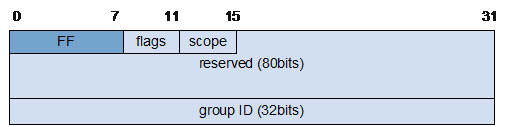
An IPv6 multicast address starts with FF.
The 4-bit flags field indicates the multicast type. Values in this field are defined as follows:
0: well-known multicast address defined by the IANA
1: multicast address in the ASM group address range
2: multicast address in the ASM group address range
3: multicast addresses in the SSM group address range
Other: unassigned multicast address
The 4-bit scope field (4 bits) indicates whether a multicast group contains any node in the global address space or only the nodes of the same local network, the same site, or the same organization. Values in this field are defined as follows:
0: reserved for other multicast protocol usage
1: node/interface-local scope
2: link-local scope
3: reserved for other multicast protocol usage
4: admin-local scope
5: site-local scope
8: organization-local scope
E: global scope
F: reserved for other multicast protocol usage
Other: unassigned and can be used as a common address
Table 3 provides the scopes and meanings of fixed IPv6 multicast addresses.
Scope |
Description |
|---|---|
FF0x::/16 |
Well-known multicast addresses defined by the IANA For details, see Table 4. |
FF1x::/16 (x cannot be 1 or 2) FF2x::/16 (x cannot be 1 or 2) |
ASM addresses valid on the entire network |
FF3x::/16 (x cannot be 1 or 2) |
SSM addresses This is the default SSM group address scope and is valid on the entire network. |
Scope |
IPv6 Multicast Address |
Description |
|---|---|---|
Node/interface-local scope |
FF01:0:0:0:0:0:0:1 |
Address of all nodes (interfaces) |
FF01:0:0:0:0:0:0:2 |
Address of all routers |
|
Link-local scope |
FF02:0:0:0:0:0:0:1 |
Address of all nodes |
FF02:0:0:0:0:0:0:2 |
Address of all routers |
|
FF02:0:0:0:0:0:0:3 |
Unassigned address |
|
FF02:0:0:0:0:0:0:4 |
Address of DVMRP routers. |
|
FF02:0:0:0:0:0:0:5 |
Address of OSPF devices |
|
FF02:0:0:0:0:0:0:6 |
Address of OSPF DRs |
|
FF02:0:0:0:0:0:0:7 |
Address of ST devices |
|
FF02:0:0:0:0:0:0:8 |
Address of ST hosts |
|
FF02:0:0:0:0:0:0:9 |
Address of RIP devices |
|
FF02:0:0:0:0:0:0:A |
Address of Enhanced Interior Gateway Routing Protocol (EIGRP) devices |
|
FF02:0:0:0:0:0:0:B |
Address of mobile agents |
|
FF02:0:0:0:0:0:0:D |
Address of all PIM devices |
|
FF02:0:0:0:0:0:0:E |
Address of RSVP encapsulation devices |
|
FF02:0:0:0:0:0:1:1 |
Address of links |
|
FF02:0:0:0:0:0:1:2 |
Address of all DHCP agents |
|
FF02:0:0:0:0:1:FFXX:XXXX |
Solicited node address XX:XXXX indicates the 24 least significant bits of an IPv6 address. |
|
Site-local scope |
FF05:0:0:0:0:0:0:2 |
Address of all routers |
FF05:0:0:0:0:0:1:3 |
Address of all DHCP severs |
|
FF05:0:0:0:0:0:1:4 |
Address of all DHCP relay agents |
|
FF05:0:0:0:0:0:1:1000 to FF05:0:0:0:0:0:1:13FF |
Addresses of service locations |