Multicast Protocols
This describes the multicast protocols supported by the device, including IGMP, PIM, and MSDP, and their applications and purposes.
To implement a complete set of multicast services, various multicast protocols deployed in the network need to operate together with each other, as shown in Figure 1.
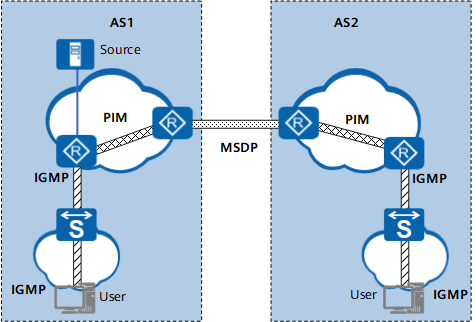
For different applications, the FW supports various multicast routing protocols depending on functions, as shown in Table 1.
Applied Location |
Objectives |
Multicast Protocol |
|---|---|---|
Between a user host and a multicast router |
Connecting a host to a multicast network:
|
Internet Group Management Protocol (IGMP) for IPv4 networks |
Between intra-domain multicast routers |
Multicast routing and forwarding:
|
Protocol Independent Multicast (PIM) |
Between inter-domain multicast routers |
Sharing the information of inter-domain multicast sources:
|
Multicast Source Discovery Protocol (MSDP) for IPv4 networks |
As shown in Table 1, the functions of multicast protocols are classified into the following two types.
Managing Member Relationships
Managing member relationship refers to setting up and maintaining member relationship between hosts and FWs.
IGMP is used to manage member relationships in IPv4 networks and has the following features:
It has three versions: IGMPv1, IGMPv2, and IGMPv3. A later version is compatible with the earlier ones. The most widely used version is IGMPv2.
The three versions support the Any-Source Multicast (ASM) model. IGMPv3 can support the Source-Specific Multicast (SSM) model independently, whereas IGMPv1 and IGMPv2 can support the SSM model only with the help of SSM mapping.
Establishing and Maintaining Multicast Routes
The multicast route, also called a multicast distribution tree, refers to the data transmission path from a multicast source to all members. The path is unidirectional, loop-free, and as short as possible. The multicast data packets are correctly and efficiently forwarded on the network only after multicast routes are established and maintained among FWs.
- Intra-domain multicast routing protocols are used to discover multicast sources and establish multicast distribution trees in the Autonomous System (AS) to deliver information to receivers. PIM is a typical intra-domain multicast routing protocol, which operates in the following two modes:
DM: indicates the Dense mode and applies to small-scale networks in which receivers are densely distributed. This mode supports the ASM model.
SM: indicates the Sparse mode and applies to large-scale networks in which receivers are sparsely distributed. This mode supports the ASM and SSM models.
Inter-domain multicast routing protocols are used to transmit multicast source information between ASs to set up inter-domain routes. The inter-domain multicast resource can be shared. MSDP is a typical inter-domain multicast routing protocol. MSDP applies to various domains that run Protocol Independent Multicast-Sparse Mode (PIM-SM).
In the SSM model, there is no distinction between inter-domain multicast protocols and intra-domain multicast protocols. Since receivers know the location of the multicast source in advance, multicast transmission path can be directly established with the help of partial PIM SM functions.