SSM Mapping
The Source Specific Multicast Mapping (SSM Mapping) mechanism enhances the compatibility of the hosts running versions earlier than IGMPv3, and ensures that these hosts can also use services in the SSM range.
The SSM mapping mechanism converts the (*,G) of IGMPv1/v2 in the SSM range into the (S,G) according to the configured conversion principle. In this manner, hosts of lower IGMP versions can also enjoy multicast services in the SSM range.
What is more, the SSM mapping mechanism can better protect the multicast source server and prevent attacks to the server.

The multicast device does not process the (*,G) requirements, but only the (S,G) requirements from the multicast group of the SSM range. For details of SSM, see Protocol Independent Multicast-Source-Specific Multicast (PIM-SSM).
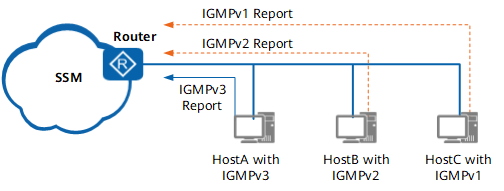
As shown in Figure 1, in the user network segment of the SSM network, Host A runs IGMPv3, Host B runs IGMPv2, and Host C runs IGMPv1. If you want Host B and Host C to provide SSM multicast services for all hosts in the network segment without upgrading their IGMP versions to IGMPv3, the multicast device needs to support SSM mapping.
If the multicast device supports SSM mapping, and is configured with the relevant conversion principle, the multicast device performs either of the following after receiving the IGMP Report messages (*,G) from Host B and Host C:
If the multicast group of the messages indicates the ASM range, see the section IGMPv1&v2&v3 for the processing method.
If the multicast group of the messages indicates the SSM range, follow the SSM mapping mechanism to convert the (*,G) of IGMPv1/v2 into the (S,G) according to the configured conversion principle.
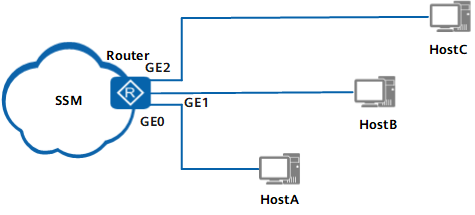
- If all the interfaces require the same SSM multicast service, configure an entry conversion principle in the IGMP view.
- If the interfaces require different SSM multicast services, configure an entry conversion principle for each interface in the system view and enable the principle on the corresponding interface.