IS-IS Multi-instance and Multi-process
IS-IS multi-instance indicates that you can configure multiple IS-IS instances on the same router.
IS-IS multi-process indicates that you can create multiple IS-IS processes in a VPN or a public network. As shown in Figure 1.
The multi-process feature allows a set of interfaces to be associated with a specific IS-IS process. This ensures that the specific IS-IS process performs all the protocol operations only on the set of interfaces. Therefore, multiple IS-IS processes can work on a single router and each process is responsible for a unique set of interfaces.
IS-IS multi-processes share an RM routing table. IS-IS multi-instances use the RM routing tables of VPNs. Each VPN has its own RM routing table.
When an IS-IS process is created, it can be associated with a VPN instance. Then, the IS-IS process belongs to the VPN and processes events only in the VPN. The IS-IS process is deleted when the associated VPN is deleted.
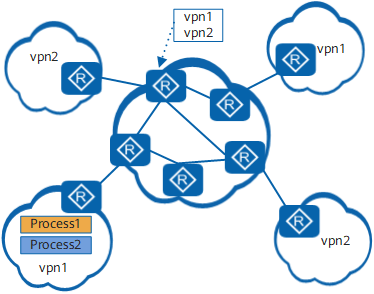
For easy management and effective control, IS-IS supports multi-process and multi-instance features.
In the scenario where IS-IS is applied to users on private networks, after a VPN is created, interfaces bound to the VPN and routes in the VPN are isolated from other VPNs and public network data. In this case, you can adopt IS-IS multi-instance to deploy IS-IS in the VPN.
For the routers that support the VPN, each IS-IS process is associated with a specific VPN instance. All the interfaces attached to an IS-IS process, therefore, should be associated with the VPN instance that this IS-IS process is associated to.
At present, the VPN instance is maintained by the VPN module. Therefore, IS-IS multi-instance is implemented by associating an IS-IS process with a VPN instance when the IS-IS process is created.
When creating IS-IS multi-instances, associate an IS-IS process with a VPN instance when the IS-IS process is created. If an IS-IS process is not associated with a VPN instance when the IS-IS process is created, the association cannot be configured later.
An IS-IS process that is already associated with a VPN instance cannot be associated with another VPN instance.
Multiple IS-IS processes can be associated with one VPN instance.
The interfaces where IS-IS multi-instance needs to be enabled must be associated with the same VPN instance as IS-IS.
The IS-IS process associated with a VPN instance belongs to the VPN. Therefore, the IS-IS process is deleted when the VPN is deleted.
Routes from different VPNs cannot be imported to each other.